


When we picture Charles M. Russell, we often imagine bucking broncos, buffalo hunts, and sweeping Montana plains. But beginning in the early 1900s, another landscape began shaping his art and his life: the soaring peaks and glacial lakes of what would become Glacier National Park.
This summer, the Sid Richardson Museum will open a new exhibition exploring Russell’s deep and enduring relationship with Glacier. Centered on the works he created in or about the park, the exhibition invites visitors to look beyond the “Cowboy Artist” and discover an artist profoundly transformed by alpine wilderness.
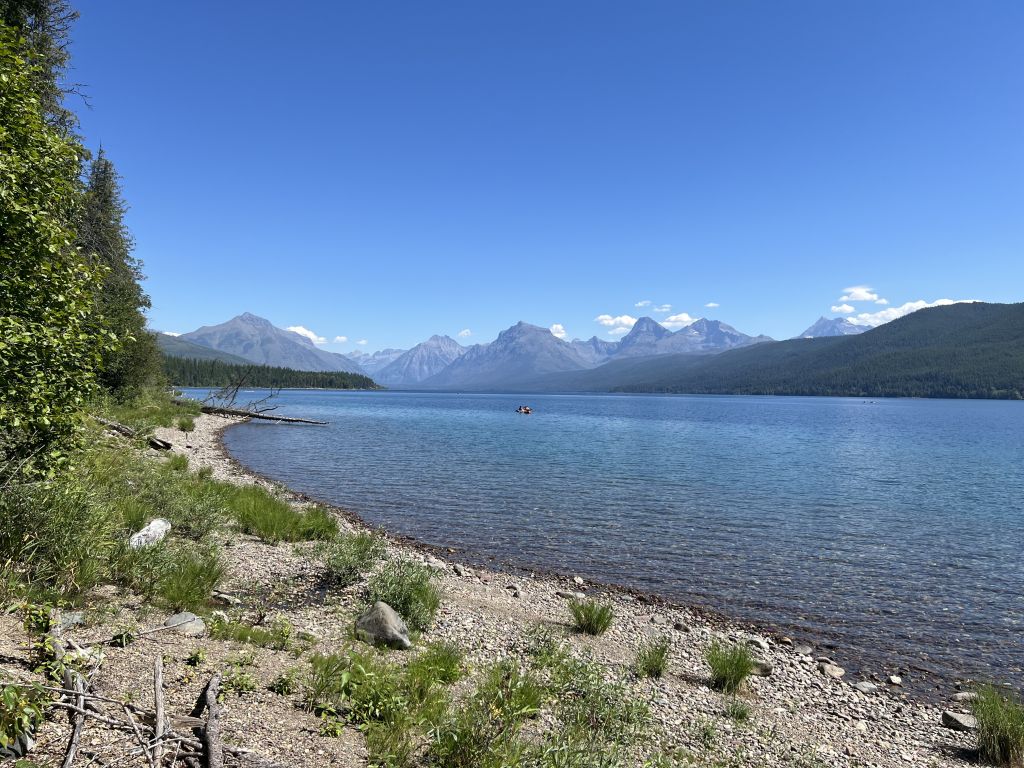
Lake McDonald, Glacier National Park
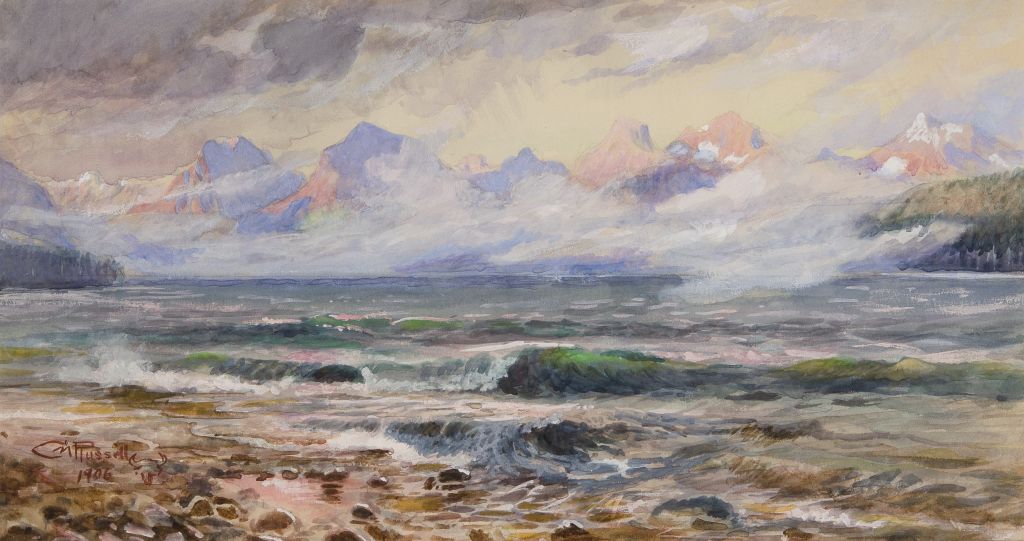
Charles Russell, Storm Over Lake McDonald, 1906, watercolor and gouache on paper, C.M. Russell Museum
Around 1904–1905, Russell and his wife, Nancy, built a rustic summer cabin on the shores of Lake McDonald. They called it Bull Head Lodge, a name inspired by Russell’s personal symbol, the buffalo skull that accompanied his signature.
For the next twenty years, the Russells spent nearly every summer there.
Life at Bull Head Lodge was simple and unvarnished. Water came from a spring. Bathing happened in the lake. Supplies were ferried by rowboat. Guests slept on fold-down beds separated by muslin “registration screens” that they signed like a living guestbook. Yet this modest cabin became one of the most important creative spaces of Russell’s career.
Here, he sketched on woodland trails. He studied clouds rolling over the Continental Divide. He watched deer emerge at dusk. He hiked to Sperry Glacier. He told stories around campfires. And he painted.
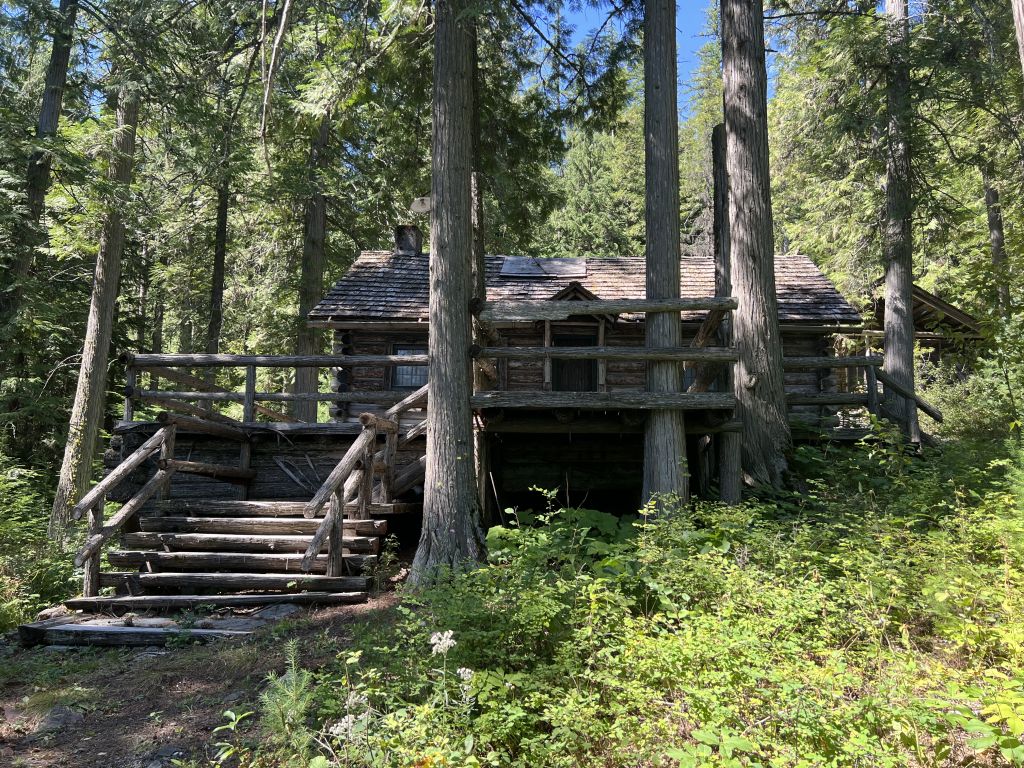
Bull Head Lodge, Glacier National Park
Russell’s reputation was built on action: dramatic scenes of cowboys, Blackfeet warriors, buffalo hunts, and frontier confrontations. But Glacier broadened his artistic vocabulary.
In the mountains, he found something different from the charged narratives of the plains: quiet.
Works such as Storm on Lake McDonald (1906) and later depictions of deer, elk, and bighorn sheep reveal a noticeable shift. Humans recede. Wildlife stands sovereign. Light becomes atmospheric and contemplative. The compositions breathe.
In these paintings, Glacier is not backdrop. It is protagonist.
Mountain passes glow in evening light. Lakes hold reflections like mirrors. Forest interiors feel hushed. Even when hunters appear, the wilderness often seems to assert its own authority, leaving outcomes unresolved. The mood is less theatrical, more reflective.
Scholars have noted that Russell’s later years introduced richer color, dramatic sunsets, and a spiritual stillness not always present in his earlier work. Glacier, with its vastness and vertical drama, offered a different kind of inspiration, one grounded in observation rather than legend.
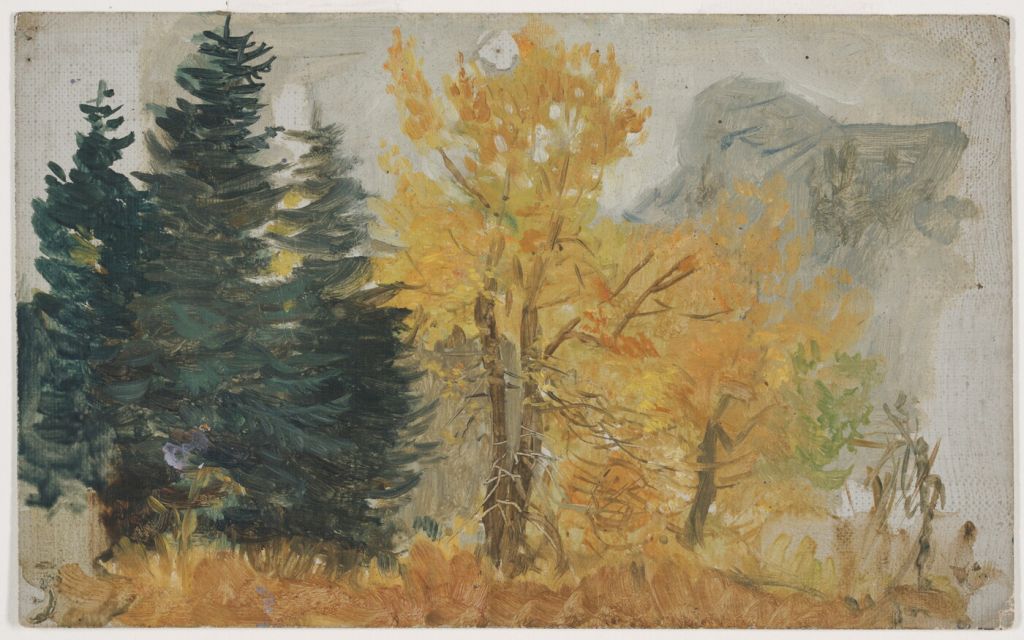
Charles M. Russell (1864–1926), [Conifers with aspens in autumn foliage], ca. 1910, Oil on canvas, Amon Carter Museum of American Art, Fort Worth, Texas, Amon G. Carter Collection by gift of C. R. Smith in 1946, 1961.351
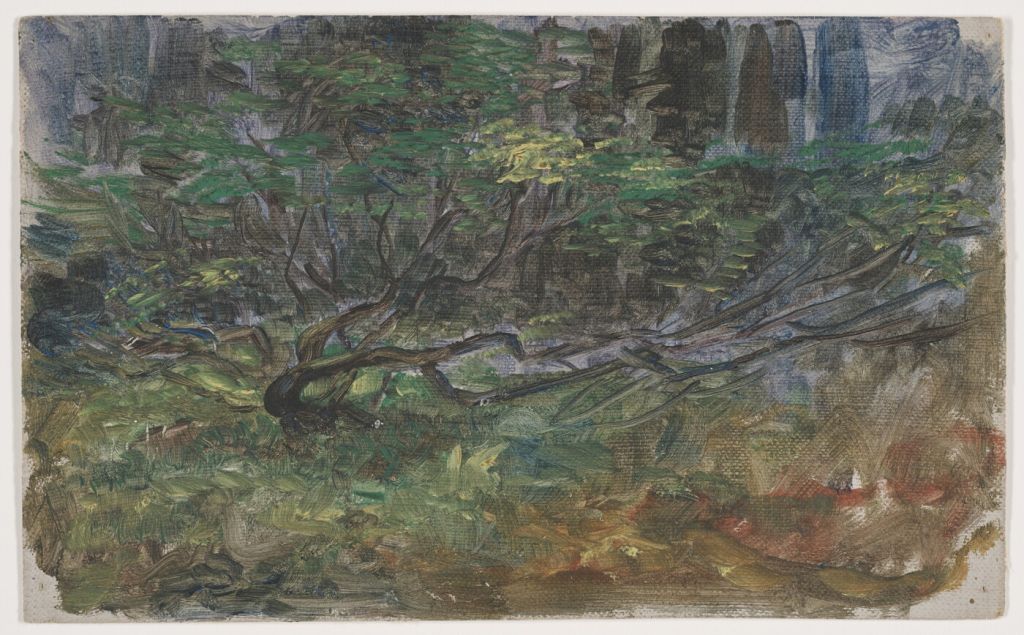
Charles M. Russell (1864–1926), [Forest undergrowth], ca. 1910, Oil on canvas, Amon Carter Museum of American Art, Fort Worth, Texas, Amon G. Carter Collection by gift of C. R. Smith in 1946, 1961.337
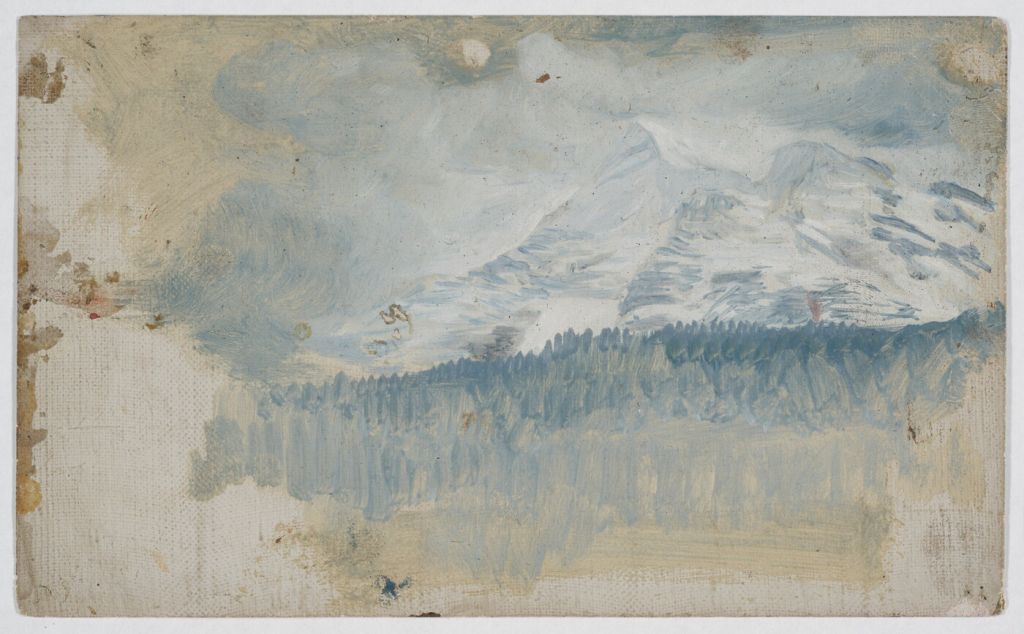
Charles M. Russell (1864–1926), [Going-to-the-Sun Mountain, Glacier Park], ca. 1910, Oil on canvas, Amon Carter Museum of American Art, Fort Worth, Texas, Amon G. Carter Collection by gift of C. R. Smith in 1946, 1961.331
Russell arrived in Montana as a teenager in 1880, chasing the mythic West he’d devoured in dime novels. By the time Glacier National Park was officially established in 1910, that mythic frontier was rapidly disappearing.
The creation of the park stirred mixed feelings. Russell valued the protection of wildlife and the preservation of wild spaces. Yet he also worried that increasing tourism and mechanization might disturb the solitude he cherished. In letters written from Bull Head Lodge, he praised horseback travel as the only true way to experience “God’s own country,” gently poking at the rise of automobiles.
He often described himself as a “harmless hunter,” and stories from friends recall his tenderness toward animals. In many Glacier-era works, animals appear not as quarry, but as dignified inhabitants of an ancient landscape. Mountains, unlike cow towns or battlefields, are timeless.
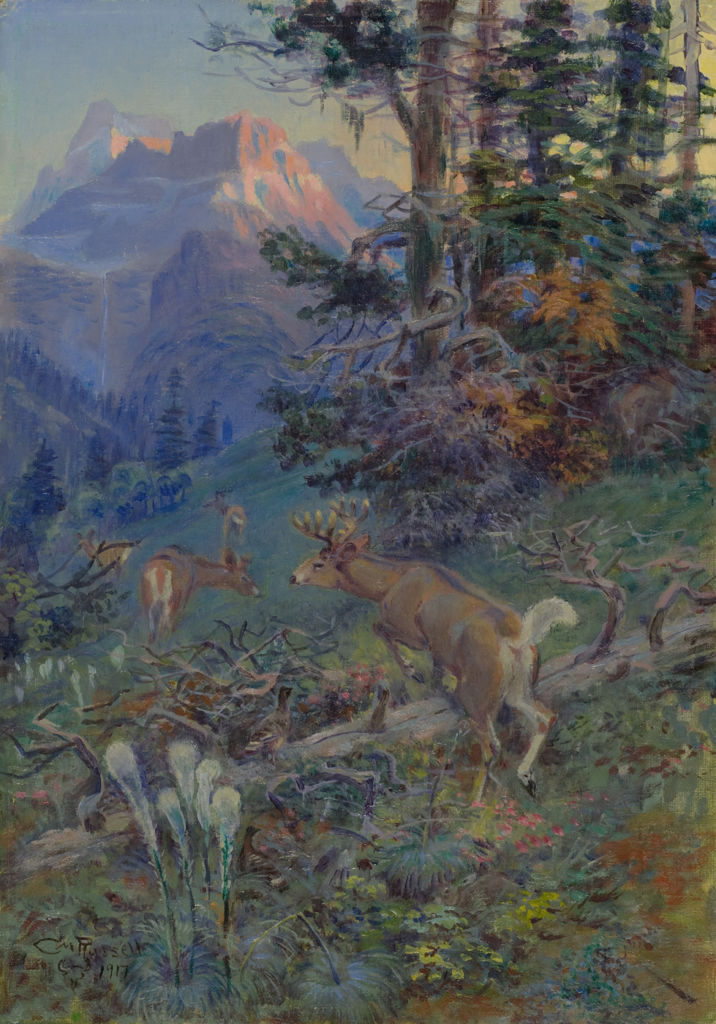
Charles M. Russell, Deer in Forest (White Tailed Deer), 1917, Oil on canvasboard, 14 x 9.875 inches
While Glacier offered solitude, it also offered community.
Bull Head Lodge became a gathering place for artists, writers, wranglers, and well-heeled tourists. Russell entertained guests with storytelling and humor, often sketching caricatures of “dudes” in oversized hats attempting to conquer wilderness terrain.
His illustrated letters from Glacier are artworks in themselves, filled with watercolor sketches of skunks under the porch, elk wading into Lake McDonald, or tourists scrambling in comic dismay. These playful images reveal an artist deeply engaged with his surroundings, observing both the grandeur and the absurdities of park life.
The exhibition highlights how this seasonal migration—away from commercial pressures in Great Falls and into alpine retreat—allowed Russell to experiment more freely. Small oil studies, plein air sketches, intimate wildlife sculptures, and luminous landscapes all point to Glacier as laboratory and refuge.
For many, Russell remains the painter of a vanishing frontier. But Glacier reveals another dimension: Russell as wilderness artist.
In these works, he is less mythmaker and more witness.
He paints not just what happened, but what endures: rock, ice, timberline, animal presence. If his plains scenes capture motion and memory, his Glacier paintings capture stillness and continuity.
With this new exhibition, we invite you to encounter Russell in this alpine key. To see how summer after summer at Bull Head Lodge reshaped his artistic output. To consider how place transforms perspective. And to reflect on how early national parks—newly protected landscapes at the dawn of the twentieth century—offered artists like Russell a different vision of the American West.
We hope you’ll join us this season to explore Russell’s Retreat: Summers at Glacier National Park.
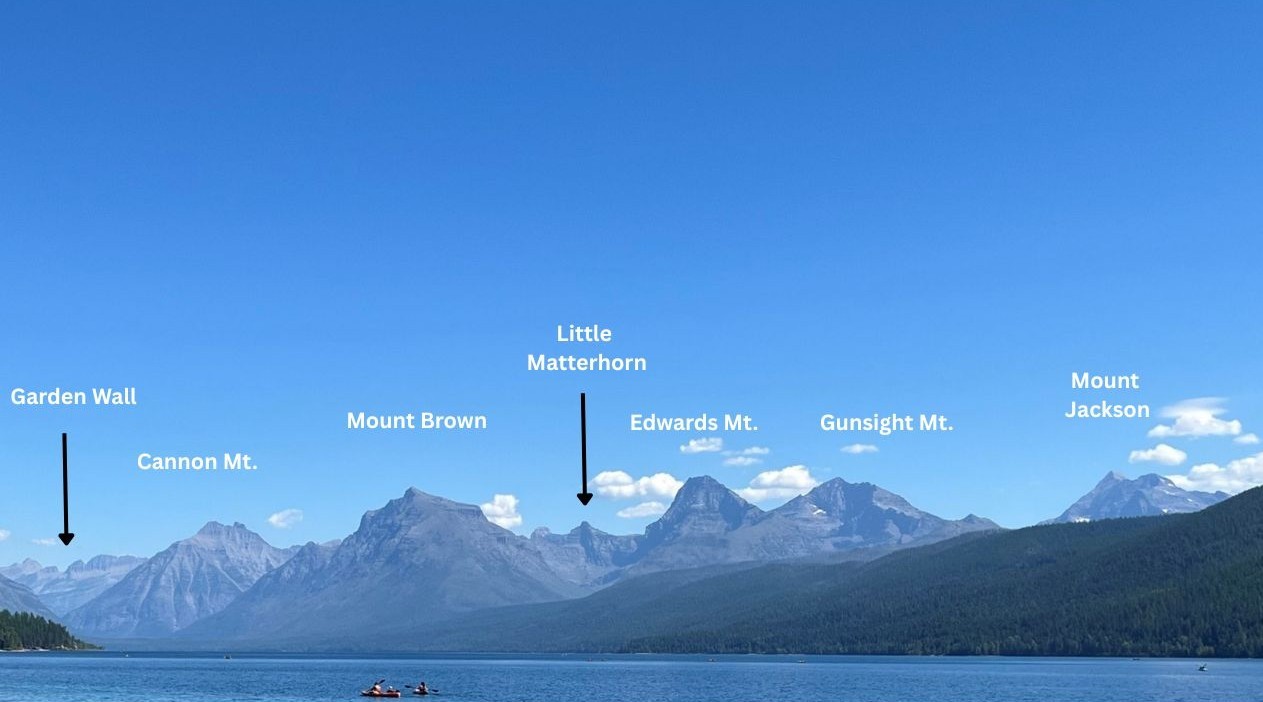
[…] recent posts, we’ve explored Charles M. Russell’s summers at Bull Head Lodge and followed author Mary Roberts Rinehart on her journey through Glacier National Park alongside […]