


On October 24, 1926, the American West lost one of its most influential visual storytellers when Charles Marion Russell died in Great Falls, Montana, at the age of 62. Known affectionately as the “Cowboy Artist,” Russell left behind far more than paintings and sculptures. He preserved an era that was already fading from memory, creating a visual record of the American frontier that continues to shape how we imagine the West a century later. As we mark the 100th anniversary of his passing, Russell’s influence remains stronger than ever.
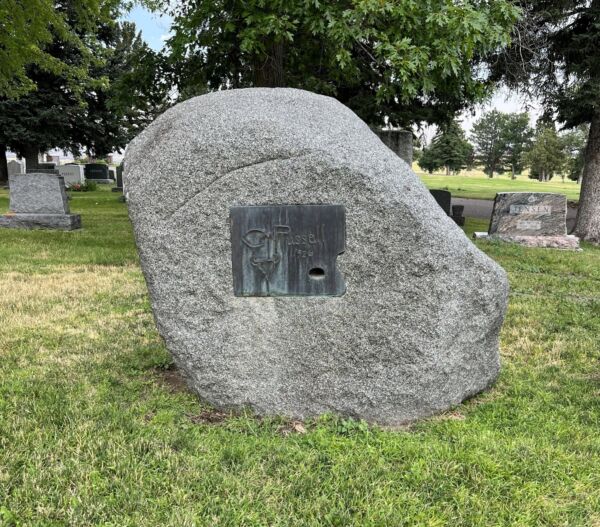
Charles M. Russell’s Grave, Highland Cemetery, Great Falls, Montana
While Charlie created the art, his wife Nancy was the driving force behind his career. She managed exhibitions, cultivated collectors, handled correspondence, and promoted his work throughout the United States. Following Russell’s death, Nancy relocated to Pasadena, California, where she continued to carefully manage his estate, and worked to place his paintings and sculptures in important public and private collections. In 1928, she sold their home the City of Great Falls for $20,000 and transferred ownership of the Russell’s studio for one dollar, with the understanding that it would serve as a memorial to the artist. When the studio opened to the public on July 4, 1930, it became the first museum dedicated to Western art. That same year, Nancy published a collection of Russell’s illustrated letters. At a time when the reputations of many artists diminished after their deaths, Nancy actively promoted Charlie’s work, helping establish him as a defining interpreter of the American West.
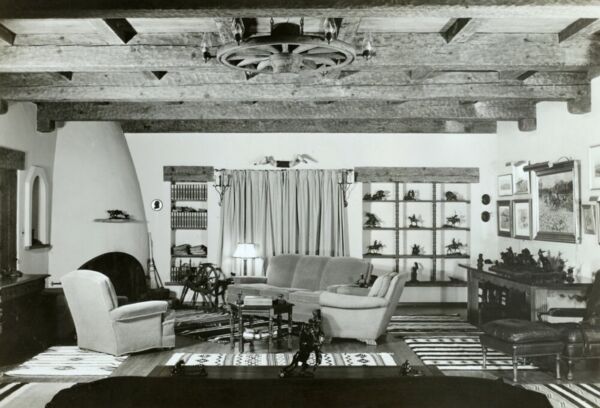
Russell Home ‘Trails End’ in Pasadena California
In the decade following Nancy Cooper Russell’s passing in 1940, a new generation of collectors began actively pursuing Russell’s art, recognizing that his paintings and sculptures preserved a disappearing frontier. As the American West became the subject of growing national nostalgia, Russell’s portrayals of cowboys, Native peoples, wildlife, and sweeping landscapes gained increasing cultural and financial value. Among the most influential collectors was Amon G. Carter of Fort Worth, who was introduced to Russell’s work through his friend Will Rogers and assembled a substantial collection with the goal of establishing a museum to house it. At the same time, Carter’s friend Sid W. Richardson built a small but exceptionally refined collection of Western art that today includes fifty-three works by Russell. Fellow collectors Thomas Gilcrease and R. W. Norton also amassed significant holdings of Russell’s art, that would form the foundation of major museums in Tulsa, Oklahoma, and Shreveport, Louisiana.
The most important institutional development in preserving Russell’s legacy came in 1951 when his neighbor and longtime friend Josephine Trigg died, bequeathing her collection of 153 Russell paintings, watercolors, illustrated letters, and related materials to the City of Great Falls. Her gift was contingent upon the city constructing a museum to house the collection within two years. Built on the site of Trigg’s former home across the block from the Russell residence, the Trigg-Russell Museum opened in September 1953 and was renamed the C. M. Russell Museum in 1972. Today, it houses the largest collection of Russell’s art and research materials and stands among the most comprehensive museums devoted to a single American artist.
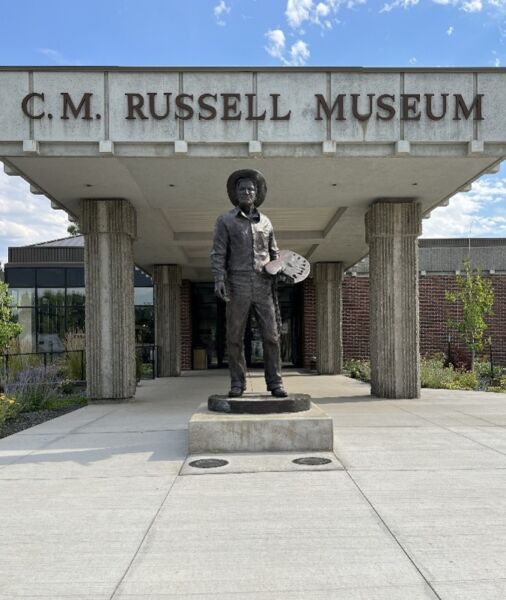
Entrance, C. M. Russell Museum in Great Falls, Montana
Recognition of Russell’s significance continued to grow throughout the twentieth century. In 1936, the Fort Peck Game Range was established on federal lands in Montana’s Missouri River Breaks country. In 1963, it was renamed the Charles M. Russell National Wildlife Range in tribute to the artist whose paintings immortalized the region’s landscapes and wildlife, and in 1976 its designation was changed to the Charles M. Russell National Wildlife Refuge, a name it retains today. In 1959, a bronze sculpture of Russell by John B. Weaver was installed in the National Statuary Hall of the United States Capitol, honoring Montana’s most celebrated artist. The growth of institutions dedicated to Western art further strengthened Russell’s reputation. The National Cowboy Hall of Fame and Western Heritage Center was founded in 1955 and opened in Oklahoma City in 1965, while the Whitney Western Art Museum, established as part of the Buffalo Bill Center of the West in Cody, Wyoming, opened in 1959. Both institutions today preserve significant collections of Russell’s art and research materials.
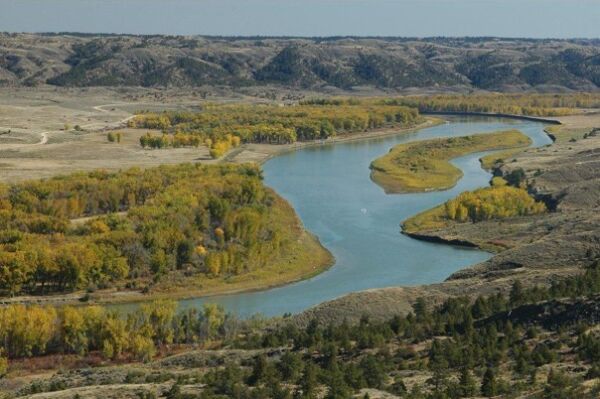
Charles M. Russell National Wildlife Refuge
Founded in 1998 through a gift from the estate of Nancy Cooper Russell and matching support from the University of Oklahoma, the Charles M. Russell Center for the Study of Art of the American West opened in Norman, Oklahoma, in September 1999. Dedicated to advancing scholarship, research, and education on the art and culture of the American West, the Center has become one of the nation’s leading institutions for the study of Western American art. Among its most significant achievements was the publication of the Charles M. Russell Catalogue Raisonné in 2007, the definitive scholarly record of Russell’s known works. Accompanied by an online database documenting more than 4,000 artworks, the project remains an indispensable resource for scholars, collectors, curators, and museums. It also represents the culmination of decades of scholarship by researchers such as Brian W. Dippie, B. Byron Price (who oversaw the Russell Center and Catalog Raisonné project), Anne Morand, Rick Stewart, and many others who have devoted their careers to documenting and interpreting Russell’s art.
The vitality of Russell scholarship is reflected in the exhibitions that continue to reinterpret his work for new audiences. Two notable exhibitions are currently on view during this centennial year. Russell’s Retreat: Summers at Glacier National Park, on view here at the Sid Richardson Museum in Fort Worth, explores the two decades Charlie and Nancy spent at their cabin on Lake McDonald. Meanwhile, Storytellers: The Blackfeet Nation and Charles M. Russell at the Denver Art Museum places Russell’s art in dialogue with ancestral Blackfeet (Nitsitapii) artworks, examining the relationships, cultural exchanges, and Indigenous knowledge that informed his vision of the West. Both exhibitions will travel to the C. M. Russell Museum in Great Falls during the summer of 2027, extending the centennial commemoration.
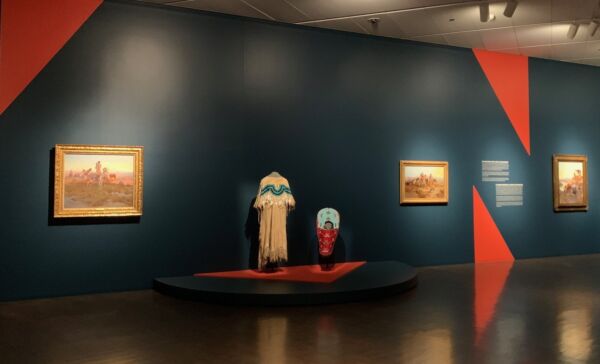
Installation view of Storytellers: The Blackfeet Nation and Charles M. Russell at the Denver Art Museum
Yet the true measure of Russell’s influence lies not in any single museum, exhibition, or publication, but in the continued relevance of his art. A century after his death, Charles M. Russell remains one of the defining interpreters of the American West. His paintings and sculptures endure not merely as records of a vanished frontier, but as powerful works of art that continue to shape how Americans imagine the landscapes, peoples, and stories of the West.
Leave A Comment