


Last month on the blog, we explored how Charles M. Russell found creative refuge each summer at Bull Head Lodge along the shores of Glacier National Park. We considered how the alpine landscape shifted his palette, softened his narratives, and invited a quieter, more contemplative vision of the West.
But what was it actually like to experience Glacier alongside Russell himself?
For that, we turn to an unexpected traveling companion: bestselling author Mary Roberts Rinehart and her lively 1916 account, Through Glacier Park.
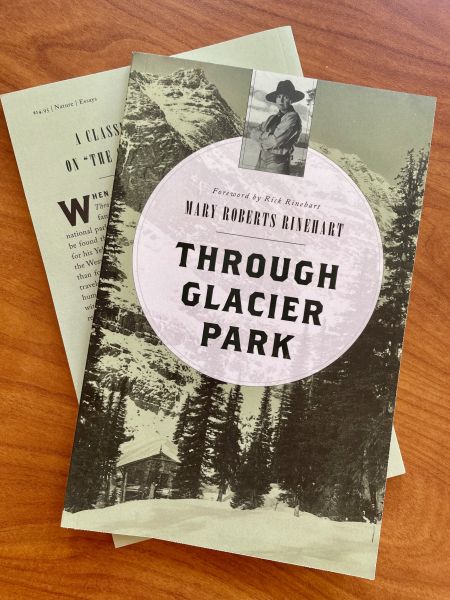
By the time Rinehart visited Glacier in the 1910s, the park was still young. It was officially established in 1910 and actively promoted by the Great Northern Railway as America’s newest scenic wonder. Rinehart, already famous for her mystery novels, arrived not as a rugged frontierswoman, but as a curious observer of a landscape that was, for many Americans, still largely imagined.
Her book is part travel narrative, part social commentary, and part affectionate character study. And at the center of it all stands Charlie Russell. Rinehart paints him not as the mythic “Cowboy Artist” of legend, but as something more intimate: a witty storyteller, an attentive horseman, a man equally at home in the saddle and at the campfire. Through her eyes, we glimpse Russell in motion: guiding visitors along mountain trails, sharing tall tales, and responding to the vastness of Glacier with both humor and reverence.
One of the most fascinating aspects of Rinehart’s account is how it captures Russell mid-career, already celebrated but still very much alive to discovery. Rinehart describes his ease in the backcountry, his preference for horses over automobiles, his comfort in canvas camps, and his affection for the animals and landscapes around him. The mountains are not stage sets for drama; they are living presences. Russell reads weather in the sky. He studies ridgelines. He gestures toward peaks as if introducing old friends.
In our exhibition, Russell’s Retreat: Summers at Glacier National Park, we focus on the physical place that grounded him each summer. Rinehart’s account adds texture to that story. She shows us how others experienced his Glacier, how visitors encountered both the grandeur of the park and the charisma of the artist who loved it.
Rinehart’s descriptions reinforce what we see in Russell’s art: a shift from high-action frontier scenes toward quieter studies of wildlife, luminous lakes, and expansive alpine views. Reading her words alongside his paintings, you begin to sense how deeply the mountains worked on him.
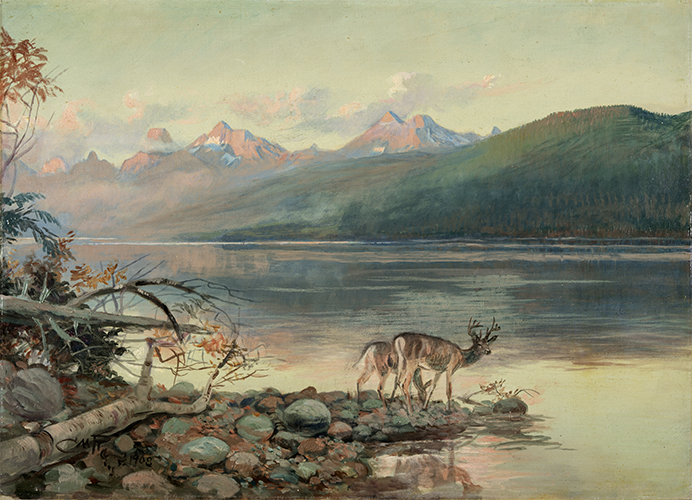
Charles Russell, Deer at Lake McDonald, 1908, oil on canvas, The Petrie Collection
Rinehart’s book also captures a pivotal cultural moment. Glacier was emerging as a destination for adventurous travelers. Wealthy tourists were willing to endure long train rides, saddle sore muscles, and unpredictable weather for the promise of sublime scenery. Camps like those near Lake McDonald and Logan Pass were equal parts wilderness immersion and curated experience.
Russell stood at an interesting crossroads within that world. He was both participant and observer. He was guiding, entertaining, and sketching. Rinehart notes his playful teasing of “dudes” unused to the rigors of mountain travel, yet she also reveals his generosity and patience. In this sense, Russell became a bridge between two Wests: the fading frontier he once knew as a young ranch hand and the protected, promoted national park landscape that Glacier was becoming.
What makes Rinehart’s book especially meaningful for our exhibition is how it helps us “read” Russell’s Glacier works more closely. When we look at a painting of Lake McDonald glowing in evening light, we can imagine the horseback journeys Rinehart describes: dust rising on the trail, the smell of pine, the sudden reveal of a glacial valley. When we study a quiet wildlife scene, we can recall her observations of Russell’s attentiveness to animals in their natural habitat. Rinehart’s prose slows us down. It encourages us to see Glacier not just as scenery, but as experience: wind, elevation, effort, companionship.
And that experiential lens aligns beautifully with the story we are telling in Russell’s Retreat. Bull Head Lodge was not simply a summer address. It was a launching point into a landscape that reshaped Russell’s imagination year after year.
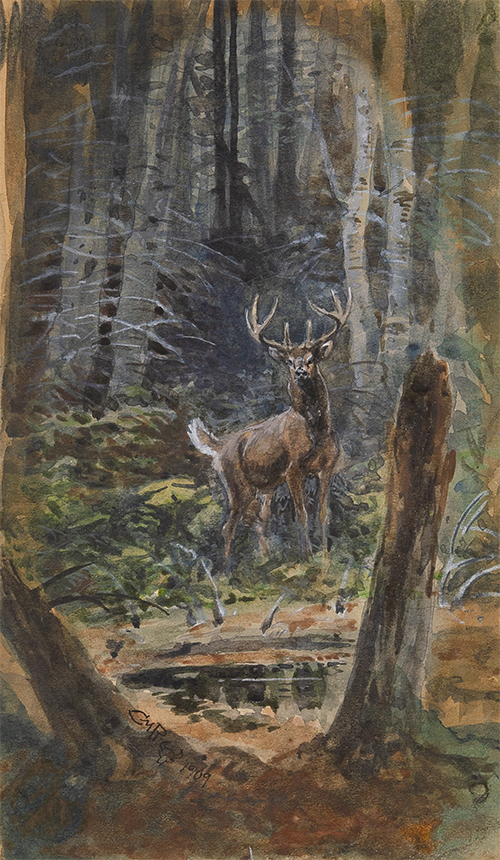
Charles Russell, Deer in the Dell, 1909, watercolor and gouache on paper, The Petrie Collection
At first glance, Through Glacier Park may seem like a period travelogue—charming, occasionally humorous, rooted in its era. But it offers something invaluable to us today: a contemporary voice witnessing Russell in the very environment that transformed his art.
In a way, Rinehart’s book becomes another artifact of Bull Head Lodge. It becomes a record of a summer, a friendship, and a landscape at a formative moment in American cultural history.
Leave A Comment