


In recent posts, we’ve explored Charles M. Russell’s summers at Bull Head Lodge and followed author Mary Roberts Rinehart on her journey through Glacier National Park alongside the celebrated “Cowboy Artist.” We’ve considered the mountain light, the storytelling around campfires, and the way Glacier’s alpine stillness reshaped Russell’s art.
But as we continue our exploration of the relationship between Russell’s artwork and Glacier National Park, it is essential to ask a more complex question:
What did it mean to create a national park in the first place?
To explore that question, we turn to historian Mark David Spence and his influential book, Dispossessing the Wilderness: Indian Removal and the Making of the National Parks.
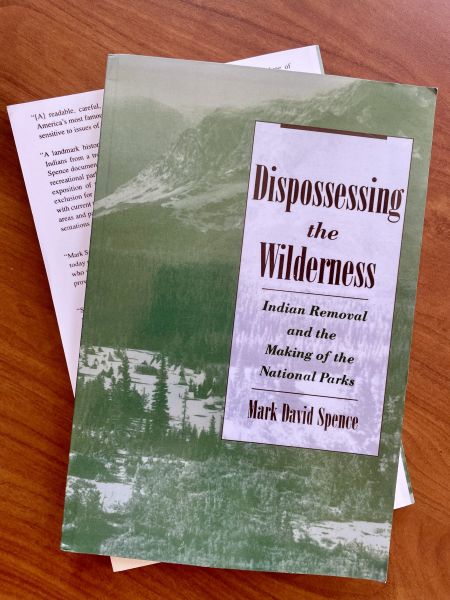
Spence challenges a powerful and persistent idea: that America’s national parks were created out of pristine, untouched wilderness. In the late nineteenth and early twentieth centuries, places like Yellowstone National Park, Yosemite National Park, and later Glacier were promoted as sublime landscapes free from human presence, cathedrals of nature set apart from modern life. But these lands were not empty. They were homelands. Spence demonstrates that the creation of early national parks often depended on the removal, restriction, or marginalization of Indigenous peoples who had long lived, hunted, and maintained deep cultural relationships with those landscapes. The idea of “wilderness” was shaped not only by scenery, but by policy.
Long before it was Glacier National Park, this region was—and remains—homeland to the Blackfeet Nation, the Confederated Salish and Kootenai Tribes, and other Indigenous communities. For the Blackfeet in particular, the eastern slopes of Glacier were—and are—sacred geography. Mountains such as Chief Mountain hold spiritual significance. Hunting routes, plant gathering areas, and origin stories are embedded in the terrain.
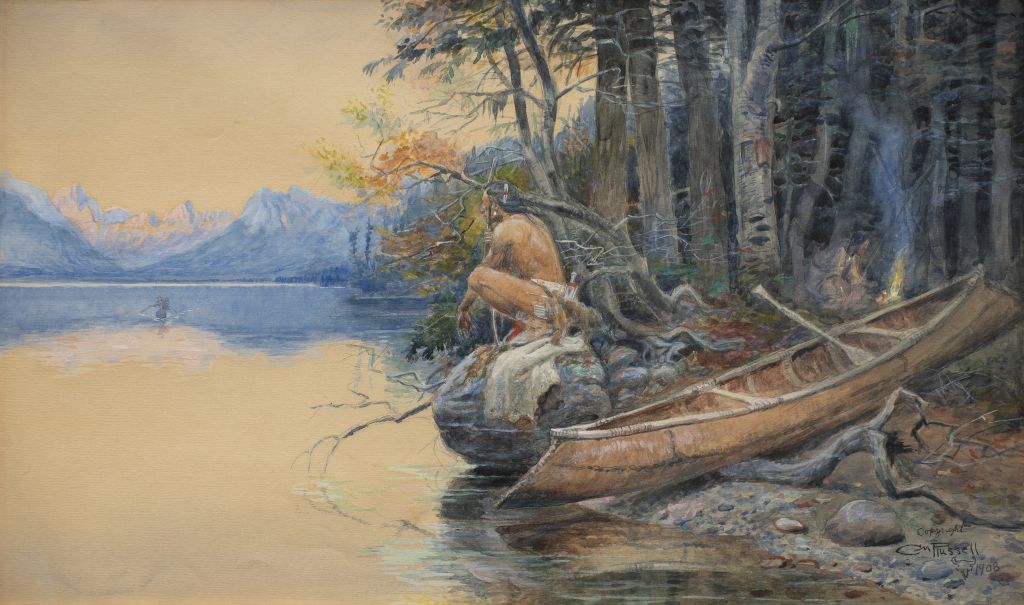
Charles Russell, Land of the Kootenai, 1908, watercolor on paper, The Petrie Collection
In 1895, the Blackfeet signed an agreement with the U.S. government often referred to as the “ceded strip.” Under mounting economic pressure and facing starvation, tribal leaders agreed to sell a large swath of mountainous land along the Continental Divide. Fifteen years later, in 1910, that land became Glacier National Park. While the agreement technically allowed continued hunting in certain areas, increasing federal regulation and shifting public attitudes toward preservation soon restricted those rights. Indigenous presence became framed as incompatible with the new conservation model.
The creation of the National Park Service in 1916 further formalized a vision of parks as carefully managed wilderness. Parks became places where modern Americans could encounter “nature” in its supposedly original state. And yet that state was deeply constructed. Railroads promoted tourism. Hotels rose along lakeshores. Roads cut across valleys. Promotional materials often romanticized Native cultures while simultaneously excluding Native communities from meaningful presence within park boundaries. This paradox sits at the heart of Glacier’s history. The park preserved extraordinary landscapes, but its preservation was entangled with dispossession.
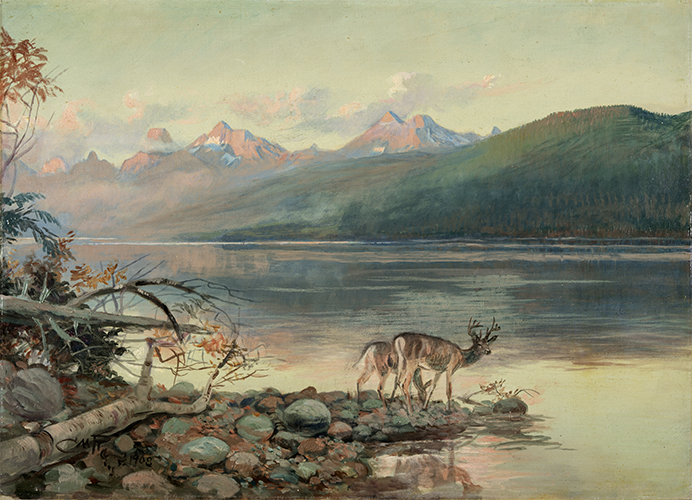
Charles Russell, Deer at Lake McDonald, 1908, oil on canvas, The Petrie Collection
When Charles M. Russell built Bull Head Lodge on Lake McDonald in the early 1900s, Glacier was on the cusp of becoming a national park. He loved its expansiveness and supported wildlife protection. Yet he also expressed concern about modernization and the growing influx of tourists. Russell’s Glacier paintings frequently remove human figures altogether. Mountains, lakes, and wildlife dominate the canvas. The effect is serene and reverent, but it also aligns with the broader cultural shift toward imagining parks as people-less wilderness.
Learning about these complex histories does not diminish the beauty of Glacier or the power of Russell’s art. Instead, it deepens our understanding. It reminds us that landscapes are layered with geological time, cultural memory, federal policy, tourism promotion, and even artistic interpretation. When we stand before Russell’s luminous mountain scenes in the exhibition, we can admire their color and composition. We can feel the alpine air and evening stillness. And we can also acknowledge that this place has always been more than scenic backdrop. Glacier is a dynamic, contested, and meaningful landscape, one shaped by the many people, histories, and ideas that have intersected there.
Leave A Comment