


When most people think of Charles M. Russell, they imagine sweeping narratives of the American West: buffalo hunts, cowboys on horseback, and dramatic encounters between people and wildlife. Yet for more than twenty summers, Russell returned to a very different kind of subject: the mountains, forests, lakes, and wildlife of Glacier National Park.
The story of Russell’s relationship with Glacier is at the heart of Russell’s Retreat: Summers at Glacier National Park, now on view at the Sid Richardson Museum. In a recent lecture, exhibition curator and museum director Scott Winterrowd explored how Glacier became much more than a summer destination for Russell. It became a place of renewal, artistic experimentation, and lasting inspiration.
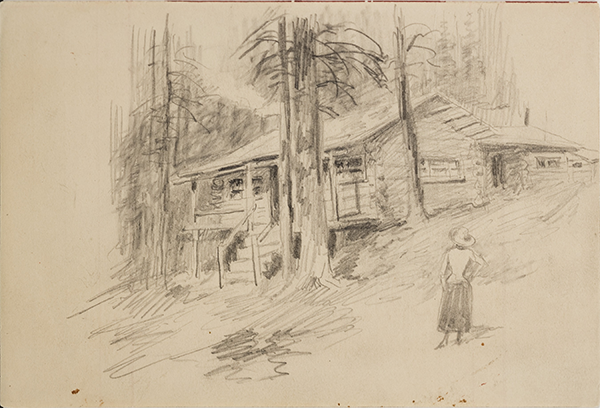
Philip R Goodwin, Untitled (Charles Russell’s Cabin at Lake McDonald, Montana), ca.1907, pencil on paper, William Sr. and Dorothy Harmsen Collection, Petrie Institute of Western Art, Denver Art Museum, 2009.321
By the early 1900s, Charles and Nancy Russell were enjoying increasing professional success. Nancy had taken a leading role in managing Russell’s career, securing publishing opportunities and expanding the market for his work. As commissions increased and travel became more demanding, the couple sought refuge from the pace of city life in Great Falls, Montana. In 1905, they purchased property on the shores of Lake McDonald. The following year, a modest cabin was constructed among the cedar trees overlooking the lake. Eventually known as Bull Head Lodge, it would become Russell’s summer home for the next two decades.
For Russell, Glacier represented an escape from the modern world he often resisted. The landscape likely reminded him of his earliest years in Montana, when he spent time in the mountains with trapper Jake Hoover, one of his first mentors. The forests and mountains around Lake McDonald offered a connection to the untamed landscapes that had first drawn him west. In a 1915 letter, Russell described the area as “about as wild a place as you can find these days—and that’s what I like.”
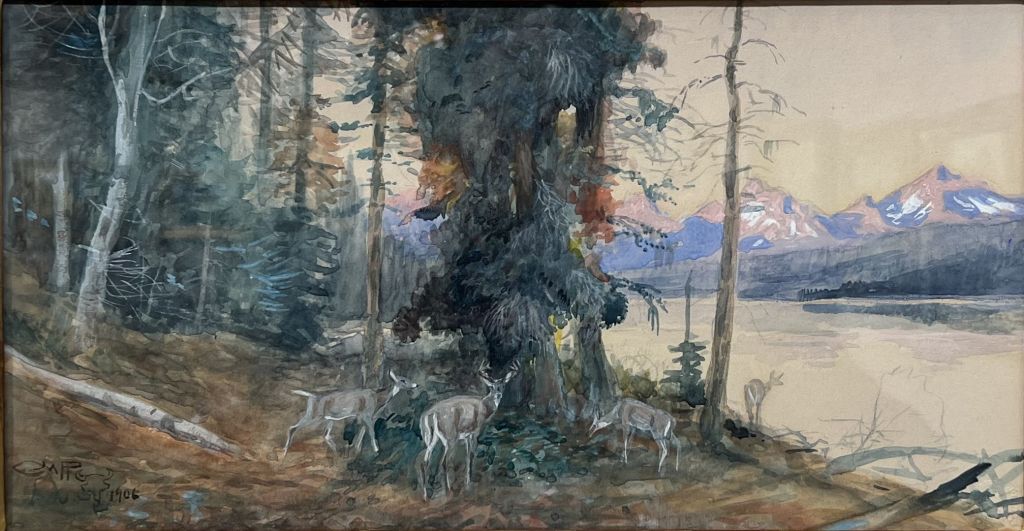
Charles Russell, Deer at Lake McDonald, 1908, oil on canvas, The Petrie Collection
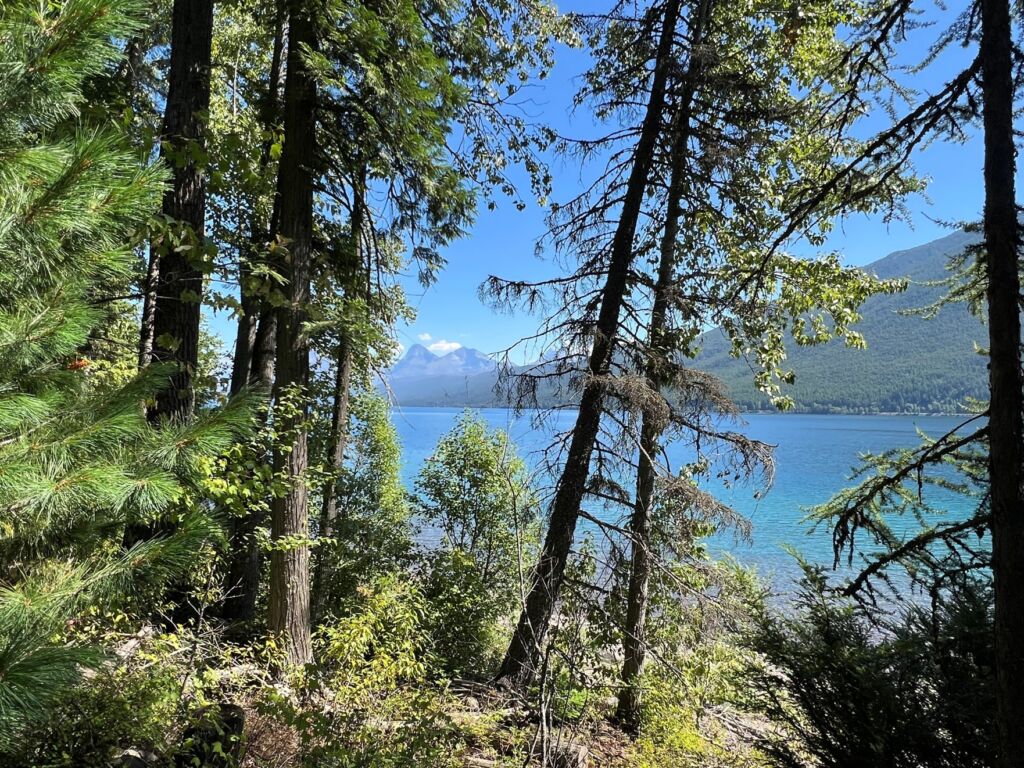
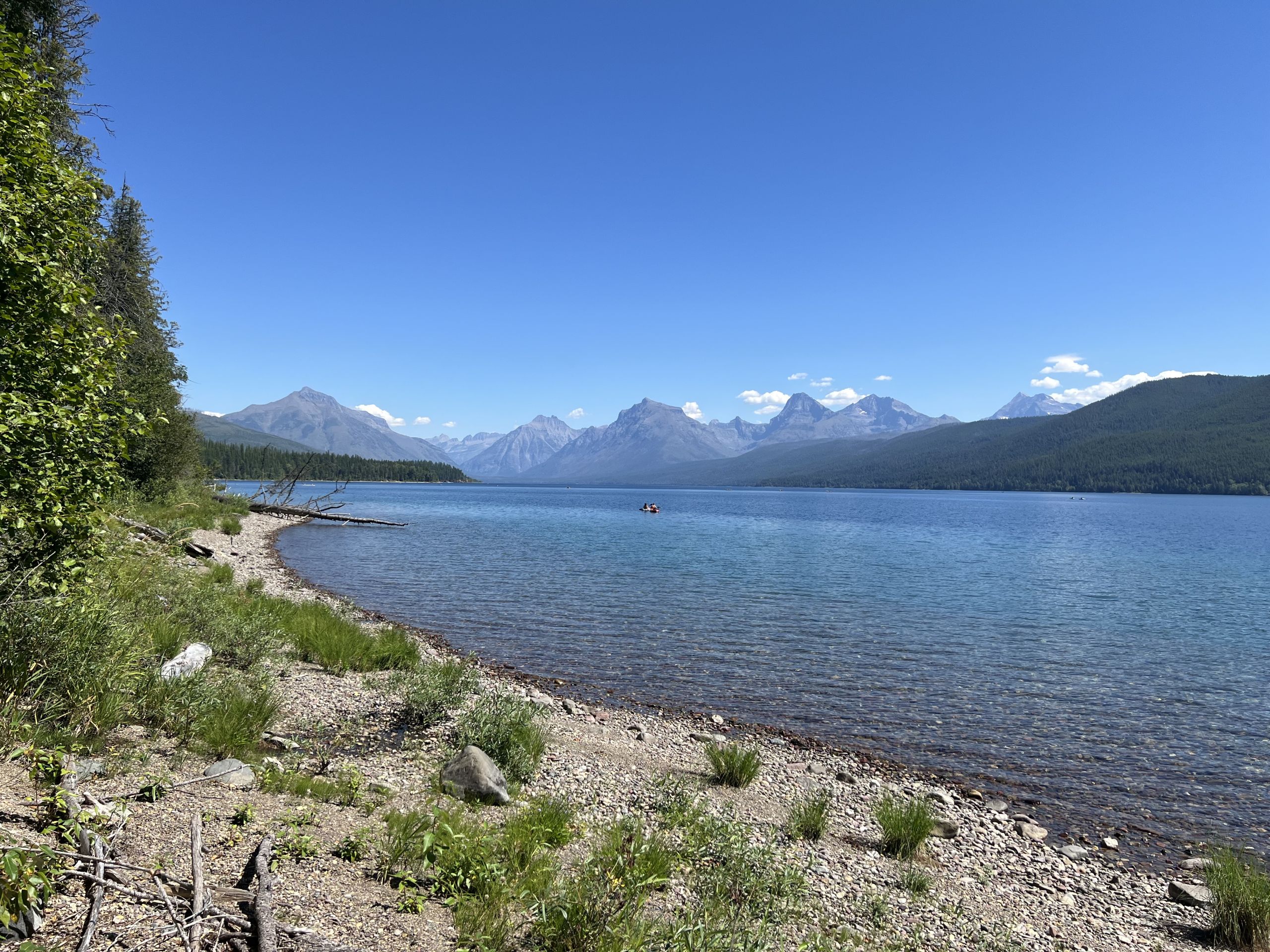
Present-day view of Lake McDonald from Bull Head Lodge
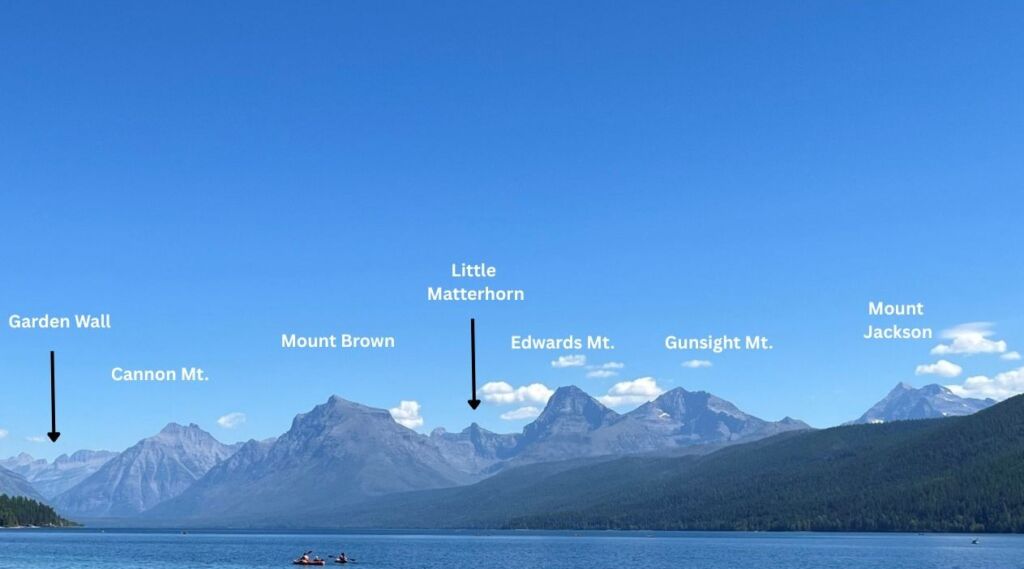
One of the most remarkable aspects of Russell’s Glacier paintings is their specificity. While Russell often rearranged landscape features in his western narratives to strengthen a composition, Glacier inspired a different approach. Mountains, valleys, waterfalls, and lakes frequently appear with surprising accuracy. From the shores of Lake McDonald, Russell repeatedly painted views of Mount Jackson, Gunsight Mountain, Mount Brown, and the Garden Wall. Visitors to the exhibition may be surprised to discover that many of these scenes can still be recognized today.
Russell also paid close attention to the details of Glacier’s ecosystem. Beargrass, thimbleberry, western red cedar, Douglas fir, ptarmigan, deer, mountain sheep, and grizzly bears all appear throughout the works created during his summers in the park. These aren’t generic wilderness scenes. They are distinctly Glacier.
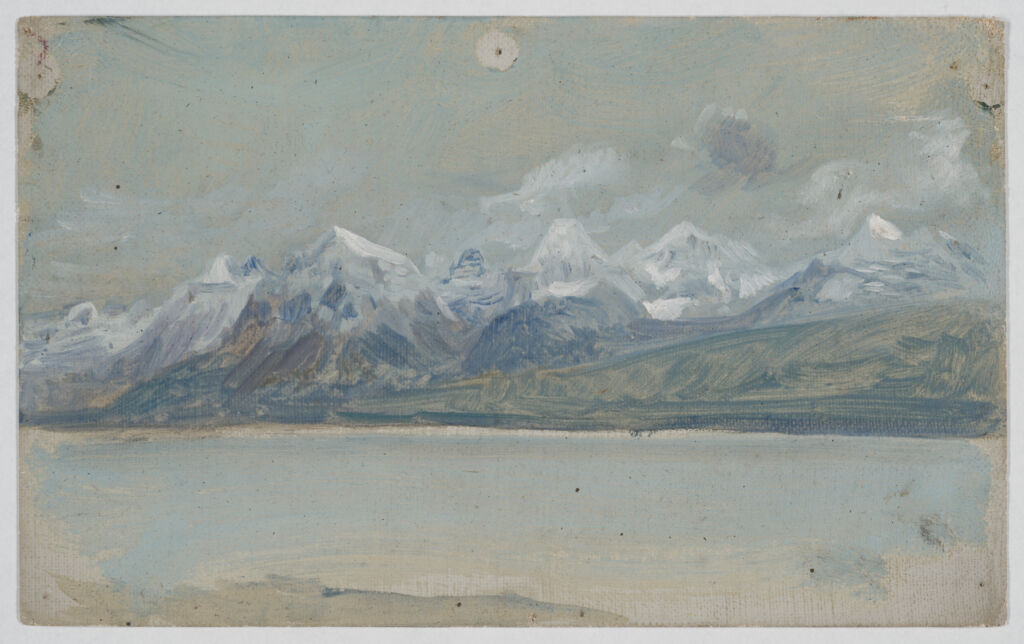
Charles M. Russell (1864–1926), [Mountain peaks, Glacier Park], ca. 1910, Oil on canvas, Amon Carter Museum of American Art, Fort Worth, Texas, Amon G. Carter Collection by gift of C. R. Smith in 1946, 1961.336
Though Glacier offered respite from professional obligations, Russell never stopped making art. Bull Head Lodge functioned as both home and studio. Friends, fellow artists, and visitors regularly joined the Russells during the summer months. The cabin became a creative gathering place where ideas were exchanged, sketches were made, and stories were shared.
Russell’s creativity extended beyond traditional paintings and sculptures. He decorated the lodge itself, carving drawings into the fireplace, creating whimsical figures from found materials, and crafting playful objects from birch bark and tree fungus. Two small gnome-like figures known as “Happy Man” and “Sad Man” even stood guard at the entrance to the lodge. The spirit of play and invention that animated Russell’s storytelling also infused life at Bull Head Lodge.
Visitors signed decorative screens that served as guest registers, creating a record of the artists, friends, and family members who gathered there over the years. Today, those screens offer a fascinating glimpse into the community that formed around Russell’s mountain retreat.
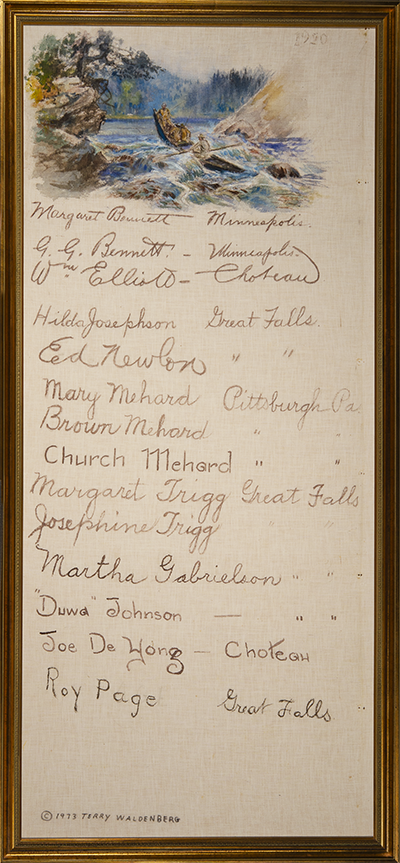
Bull Head Lodge Privacy Screen, 1920, mixed media on Muslin, Gift of Larry and LeAnne Peterson, C.M. Russell Museum, 996.27.2
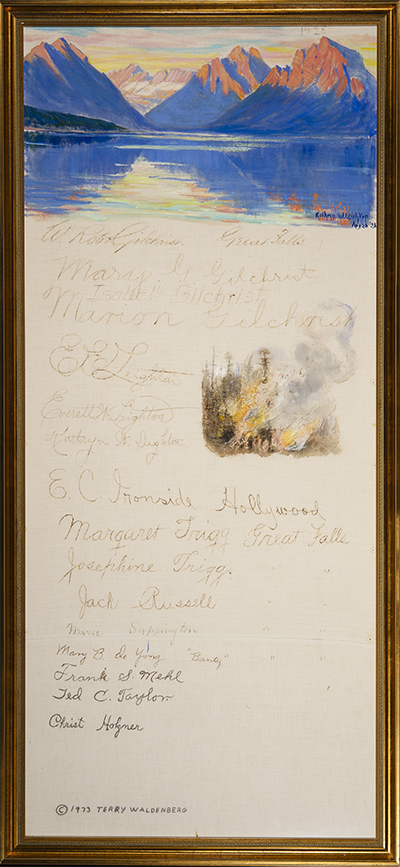
Bull Head Lodge Privacy Screen, 1925, mixed media on muslin, Gift of Larry and LeAnne Peterson, C.M. Russell museum, 996.26.6
Early Glacier works often focus on intimate views around Lake McDonald—storm clouds gathering over the water, deer emerging from the forest, or sunlight filtering through cedar branches. These paintings reveal a quieter and more contemplative side of the artist. As the years progressed, Glacier’s influence became even more apparent. Russell ventured farther into the park, sketching along mountain trails and at high elevations. Dramatic landscapes around Logan Pass, Going-to-the-Sun Mountain, and Bird Woman Falls began appearing in his paintings. Even when he continued creating narrative scenes involving hunters, bears, or Indigenous communities, Glacier frequently served as the setting. Rather than merely providing a backdrop, the landscape became an active participant in the story.
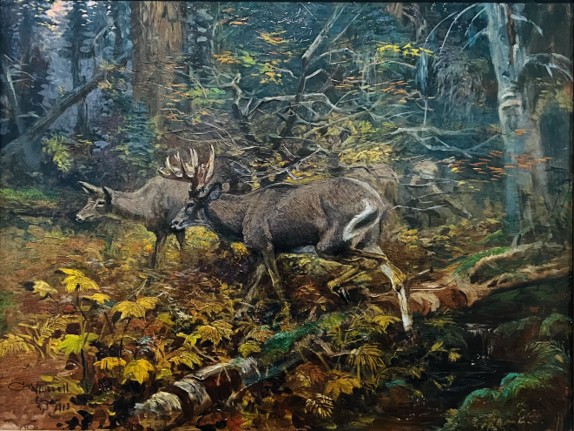
Charles Russell, Deer in the Forest, 1913, oil on canvas, The Josephine Trigg Collection, C.M. Russell Museum
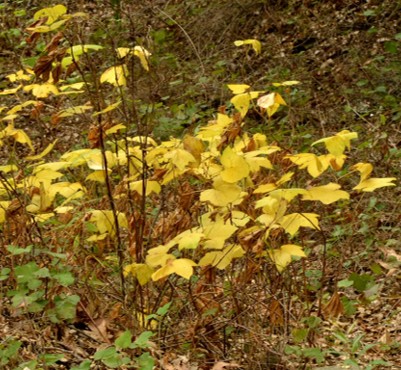
Thimbleberry in Autumn
Many early Glacier paintings feature natural earth tones, but later works increasingly embrace cool blues, atmospheric violets, and luminous color effects. Russell became captivated by Glacier’s unique visual qualities: the vast distances, changing mountain light, and blue atmospheric haze that settles over the landscape. Visitors can see this evolution throughout the museum’s exhibition. Comparing works painted years apart reveals how Russell’s palette gradually became more chromatic and expressive. The transformation suggests that Glacier did more than provide new subject matter. It reshaped how Russell saw and painted the world.
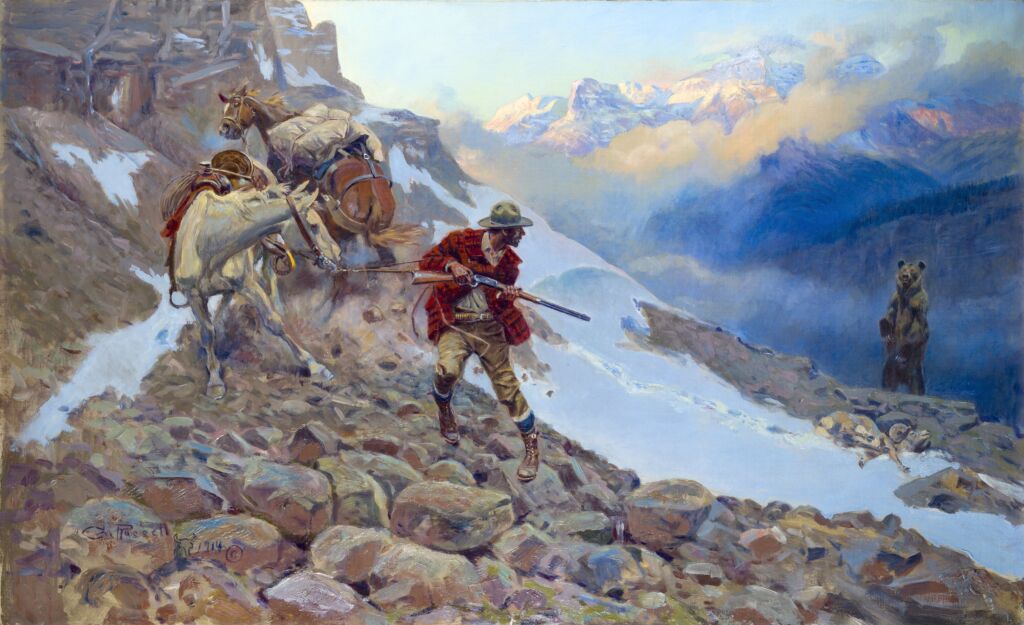
Charles Russell, Whose Meat?, 1914, oil on canvas, The Petrie Collection
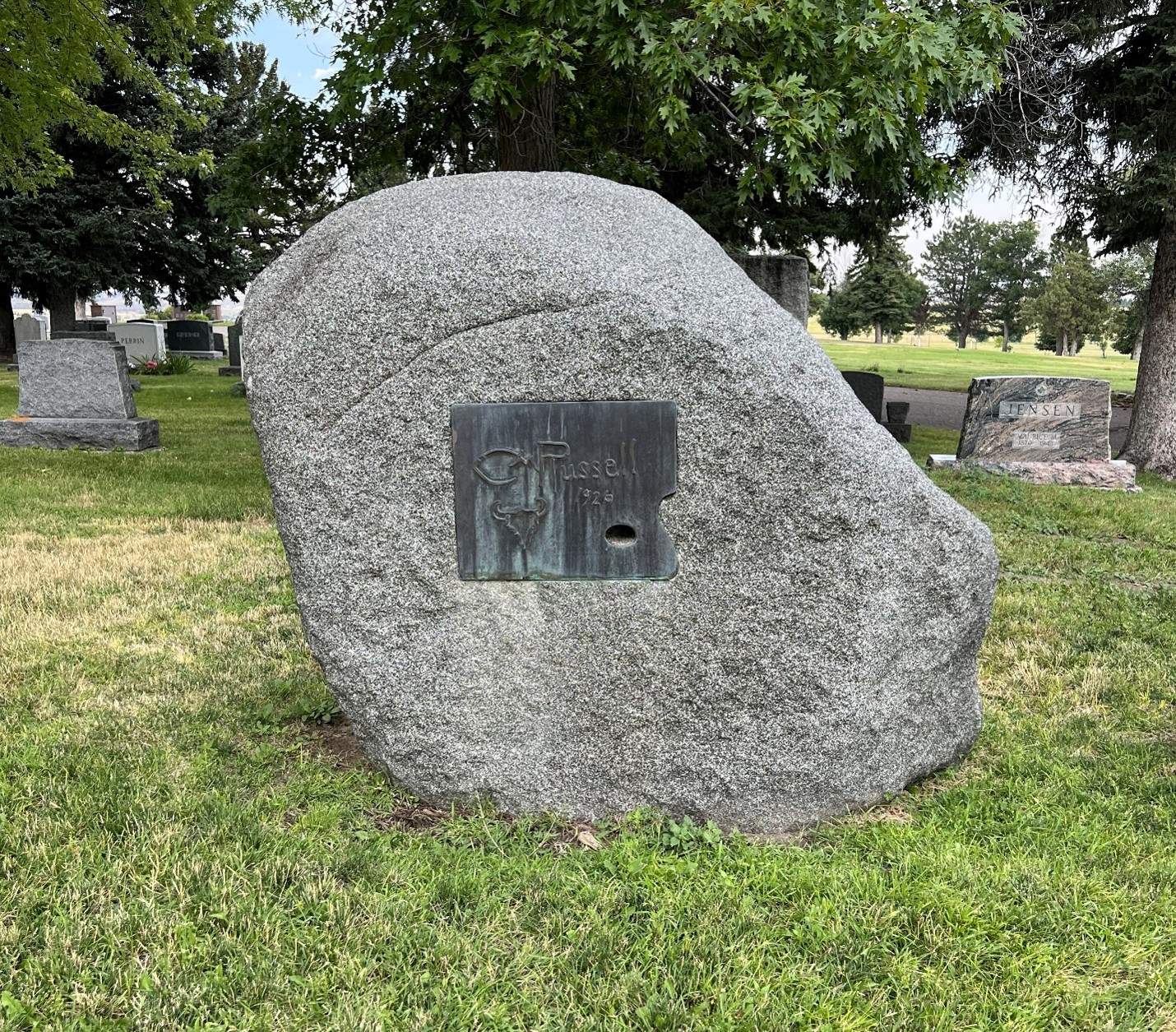
Bull Head Lodge remained central to Russell’s life until the very end. In 1925, after surgery and worsening health concerns, Charles and Nancy returned once again to Lake McDonald seeking rest and recovery. Despite physical challenges, Russell continued painting, welcoming guests, and spending time in the place he loved most. Wildfires threatened the area that summer, coming dangerously close to Bull Head Lodge before changing course. The cabin survived, but Russell’s health continued to decline. He died on October 24, 1926, at age sixty-two. A century later, Glacier remains inseparable from his artistic legacy.
Russell’s Retreat: Summers at Glacier National Park invites visitors to encounter a side of Charles Russell that is often overshadowed by his famous cowboy narratives. Here we meet an artist captivated by mountain light, fascinated by native plants and wildlife, and deeply connected to a specific place. We see a painter who found inspiration not only in dramatic stories, but also in quiet moments beside a lake, beneath towering cedars, or high above the valleys of Glacier. The exhibition reminds us that Glacier was more than Russell’s summer destination. It was his retreat, his studio, and ultimately one of the most important landscapes of his artistic life.
If you’d like to take a deeper dive into these themes and hear Scott Winterrowd’s full talk, be sure to check out the recording of his recent lecture, “Under the Spell of the Lake Country: Charles Russell and Glacier National Park.”
Leave A Comment