


Few animals loom larger in the art of Charles M. Russell than the grizzly bear.
In our exhibition, Russell’s Retreat: Summers at Glacier National Park, the grizzly appears again and again, not merely as wildlife, but as symbol, adversary, storyteller, and force of nature. Along the rugged slopes of Glacier National Park, Russell found in the bear a subject equal to the mountains themselves: powerful, unpredictable, and unforgettable.
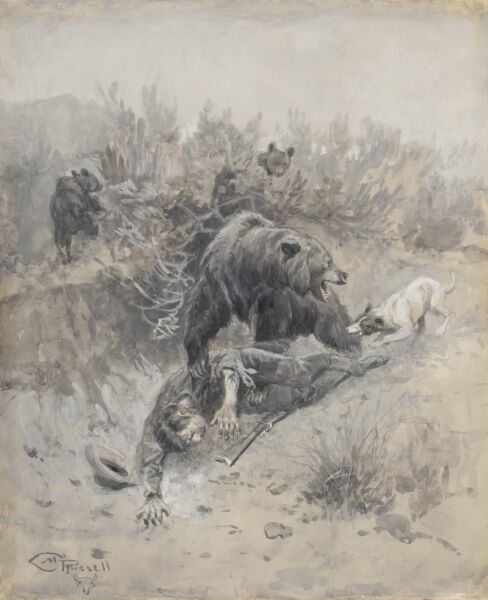
Charles Russell, He Tripped and Fell Into a Den on a Mother Bear and Her Cubs, 1910, watercolor, pencil & gouache on paper, Sid Richardson Museum
From his earliest summers in Glacier, Russell seized upon the image of the grizzly as a powerful narrative device. In his paintings, the bear often becomes the ultimate test in scenes that pit man against beast in tense struggles for survival. Even when drawing from tales involving smaller black bears, Russell frequently transformed the animal into a grizzly. They’re larger, more imposing, more dramatic. The choice was deliberate. The grizzly embodied untamed wilderness. It raised the stakes.
In Whose Meat? (1914), a hunter who has successfully taken his game suddenly finds himself in a far more precarious position. A grizzly enters the frame. The man and his horses scramble on a rocky slope along the Continental Divide. Russell sets the scene at the most suspenseful moment. We do not know what happens next. These so-called “predicament paintings” leave the outcome open. The tension hangs in the mountain air.
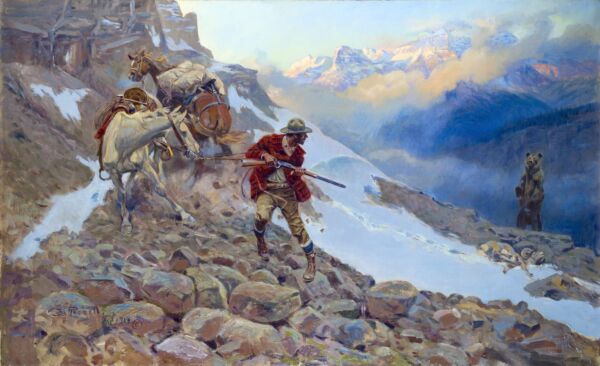
Charles Russell, Whose Meat?, 1914, oil on canvas, The Petrie Collection
Not all of Russell’s grizzlies arrive with solemn menace. In Bruin Not Bunny Turned the Leaders (1924), he blends humor with impending chaos. A stagecoach team bolts in fright. The driver assumes a rabbit springing across the road is to blame. But we, the viewers, know better. Hidden behind a glacial boulder in the foreground, a grizzly and her cubs lurk unseen. As Russell once noted, “The horse, like most animals, uses his nose before his eyes… The smell of a bear will stampede most horse.” The scene is amusing until you realize the likely ruin awaiting the stage and its passengers. Russell invites us to see what the figures cannot. It’s a masterclass in visual storytelling.
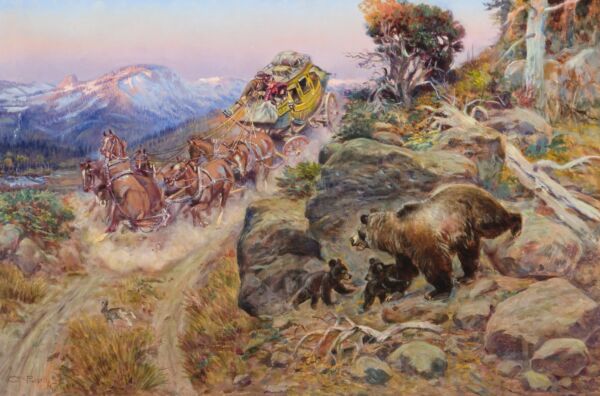
Charles Russell, Bruin Not Bunny Turned the Leaders, 1924, oil on canvas, Gilcrease Museum
Russell’s reputation as a raconteur translated seamlessly to canvas. In The Price of His Hide (1915), he revisited an earlier bear-fight subject, this time relocating the confrontation to Glacier’s mountainous terrain. The alternate title—Who Killed the Bear?—adds another layer of narrative ambiguity. Later, writing under the moniker Rawhide Rawlins, Russell would finally record the tale that inspired this dramatic scene. But on canvas, he preferred to let the story hover unresolved.
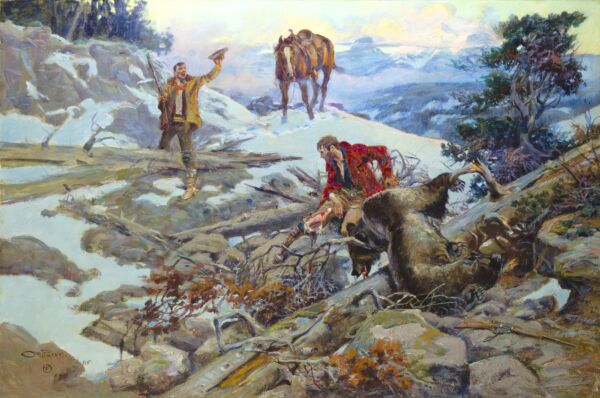
Charles Russell, The Price of His Hide, 1915, oil on canvas, The Petrie Collection
Even in more intimate works, the grizzly remains present. A 1926 birthday greeting made for his friend Lewis O. Evans features a watercolor of a solitary bear set against distant snowcapped peaks. There is tenderness here and perhaps a touch of melancholy. Russell wrote, “Many more of them to you and I wish birthdays traveled the other way.” By this time, his health was failing. The mighty bear, once a symbol of peril, becomes something quieter, enduring, elemental.
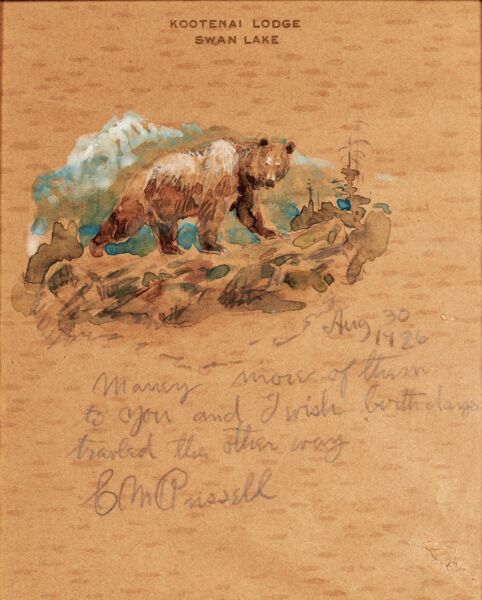
Charles Russell, Birthday Greeting for Lewis O. Evans, August 30, 1926, 1926, watercolor and goauche on paper, The Petrie Collection
While Russell painted the grizzly as an ever-present force in Glacier, reality was more fragile. By 1910, when Glacier became a national park, grizzly numbers had already plummeted after decades of hunting and trapping. The animal Russell elevated as the icon of wilderness was, in fact, increasingly vulnerable. As apex predators, grizzlies play a crucial ecological role. They help regulate prey populations and even disperse seeds through their foraging. They are both keystone species and cultural symbol.
The complicated relationship between humans and bears would continue to unfold long after Russell’s death. On August 13, 1967—later known as the “Night of the Grizzlies”—two young women were killed in separate attacks in different areas of the park. The tragedy prompted sweeping reforms: the closure of open garbage dumps, stricter campsite regulations, and modern food storage requirements. Bear management in Glacier was forever changed.
Russell’s dramatic canvases and the park’s evolving policies tell parallel stories—stories about awe, danger, misunderstanding, and the ongoing effort to coexist.
Leave A Comment