


When audiences today tune into gritty TV series like Yellowstone or Outer Range, they’re tapping into a long legacy of storytelling that dates back more than a century. In our current exhibition, The Cinematic West: The Art That Made the Movies, visitors can explore how that legacy took shape—quite literally—through the bold, colorful movie posters that helped define the Western genre in its early days. These posters weren’t just advertisements. They were promises of adventure, heroism, and the mythic West. And they are visual echoes of the dynamic artworks by Frederic Remington and Charles Russell featured alongside them in our museum galleries.
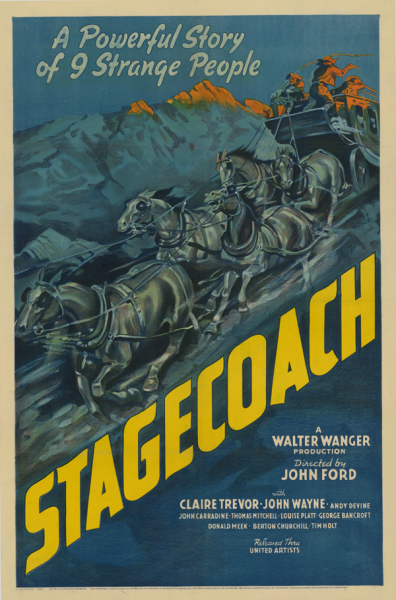
Stagecoach Movie Poster, 1939, Lithograph, Poster collection, Margaret Herrick Library, Academy of Motion Picture Arts and Sciences
Consider the 1939 poster for Stagecoach, the breakthrough film that launched John Wayne to stardom and redefined the Western for a new era. The poster’s use of dramatic angles, moonlit hues, and dynamic movement calls to mind Remington’s own depictions of night-time stagecoach scenes. In the film, that same energy culminates in one of Hollywood’s most famous stunts: Yakima Canutt sliding beneath a moving stagecoach, a moment so iconic it would later be re-created in Raiders of the Lost Ark (1981). It’s a clear throughline from painted canvas to cinematic spectacle.
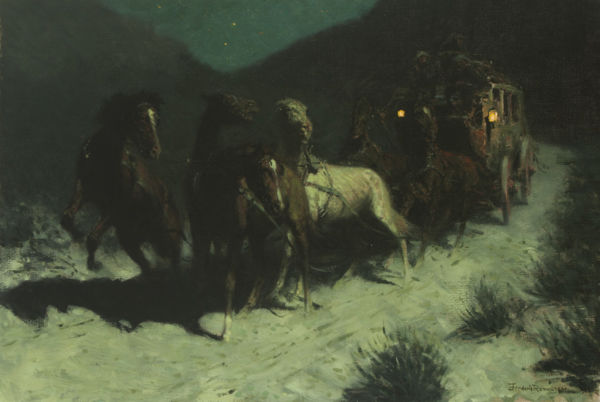
Frederic Remington, A Taint On the Wind, 1906, Oil on canvas, 27 1/8 x 40 inches
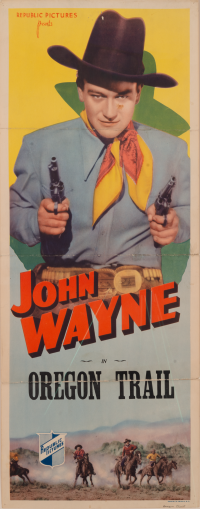
Oregon Trail Movie Poster, 1936, Photolithograph, National Cowboy & Western Heritage Museum, RC2006.068
In the 1920s and 30s, as John Wayne climbed the ranks in a string of B-movie “Horse Operas,” studios relied on eye-catching posters to hook audiences. Films like Blue Steel and Oregon Trail—now considered cliché or even lost to time—were brought vividly to life through their promotional artwork. Take the Oregon Trail poster. With its stark contrasts, bold typography, and confrontational gaze, it didn’t just sell tickets. It shaped the very archetype of the Western hero: stoic, rugged, and deeply American.
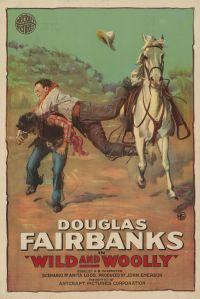
Wild and Wooly Movie Poster, Wild and Woolly Movie Poster
The H. C. Miner Litho. Co. N.Y., Lithograph, 1917, Poster collection, Margaret Herrick Library, Academy of Motion Picture Arts and Sciences, 70255991
These early posters were designed for impact. Artists employed exaggerated motion, dramatic landscapes, and iconic poses to communicate danger, romance, and rugged independence all in a single glance. In many ways, they served the same function as Remington’s bronzes or Russell’s paintings: mythologizing the West into a place of legend and spectacle.
Douglas Fairbanks’ Wild and Woolly (1917) offers a glimpse into the genre’s silent-era roots. In this rare surviving poster, Fairbanks grins with the mischief and athleticism that made him a silent film icon. Posters like this didn’t just advertise a film. They showcased personality, inviting viewers into a world of physical comedy and larger-than-life challenges. Like Russell’s painted cowboys or Remington’s galloping cavalry, Fairbanks’ character wasn’t just a man. He was a symbol of American grit and humor in equal measure.
By the time She Wore a Yellow Ribbon hit theaters in 1949, the Western had become a Hollywood staple. This poster, drenched in the rich tones of early Technicolor, places John Wayne front and center as Captain Nathan Brittles. But look closer. The warm yellows and dusty oranges that saturate the scene owe as much to Charles Russell’s palette as to the Utah desert where the movie was filmed. Russell’s love for glowing sunsets and color-soaked plains directly shaped how the West was visually imagined on screen.
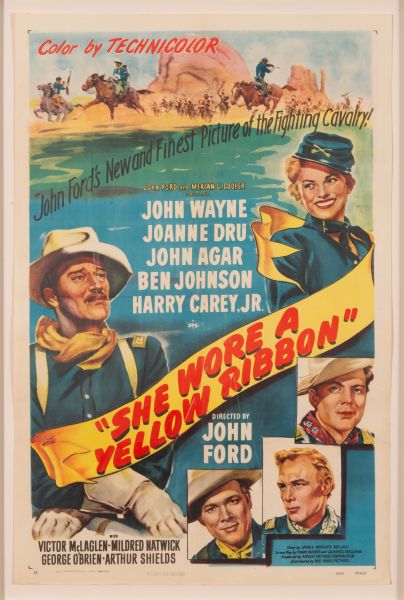
“She Wore a Yellow Ribbon,” 1949, Lithograph, National Cowboy & Western Heritage Museum, Oklahoma City, OK
Fast forward to today, and the Western is alive and well, not just in movie theaters but across streaming platforms. Series like 1883 and Godless echo the same themes: tough landscapes, tougher characters, and the relentless march toward justice or ruin. While the visual medium has changed—from hand-painted posters to digital thumbnails—the spirit of the Western remains much the same.
Why do Westerns still captivate us? Maybe it’s the simplicity of the moral universe they portray. Maybe it’s the allure of open landscapes and personal codes. Or maybe, like those vintage posters on display at the Sid Richardson Museum, they remind us of the power of image and imagination.
The Western continues to evolve, but its visual legacy—rooted in both fine art and film marketing—still shapes how we see the American frontier. Whether it’s a painted cowboy racing across a canvas or a sheriff squaring off on a poster, the story remains compelling.
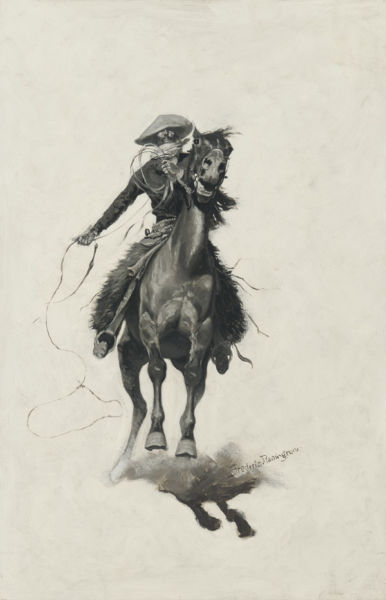
Frederic Remington, The Cow Puncher, 1901, Oil (black & white) on canvas, 28 7/8 inches x 19 inches
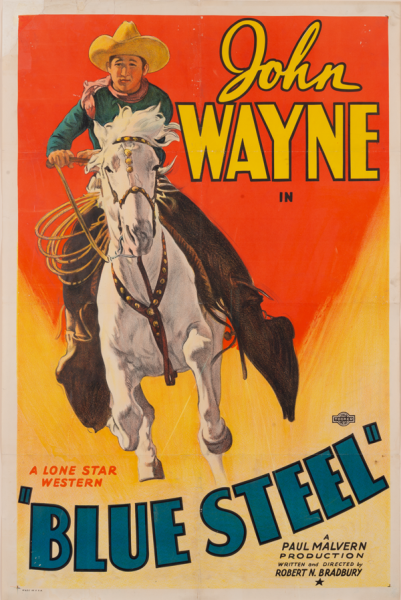
Blue Steel Movie Poster, 1934, Lithograph, National Cowboy & Western Heritage Museum, RC2006.068

Leave A Comment