


RUSSELL’S RETREAT: Summers At Glacier National Park
May 2, 2026 – April 2027
May 2, 2026 – April 2027
Russell’s Retreat: Summers At Glacier National Park explores a different side of Charles Russell, the “Cowboy Artist,” with works made at his summer retreat, Bull Head Lodge, on the southern shores of Lake McDonald in what is today Glacier National Park. The show focuses on more intimately scaled works, many of which were made as gifts to be given to friends who visited the park. Over the years Russell spent in Glacier, his paintings featuring the struggles between man and nature were set against the alpine peaks of the park’s high country. From his early days in Glacier to the artist’s late years, deer were a constant subject he would capture, most often in the dense woods surrounding his cabin.
This installation is designed to transport the viewer to Russell’s retreat in Glacier and immerse you in its surroundings. We hope you will enjoy our special exhibition, and return for programs engaging in topics related to the show in the coming year.
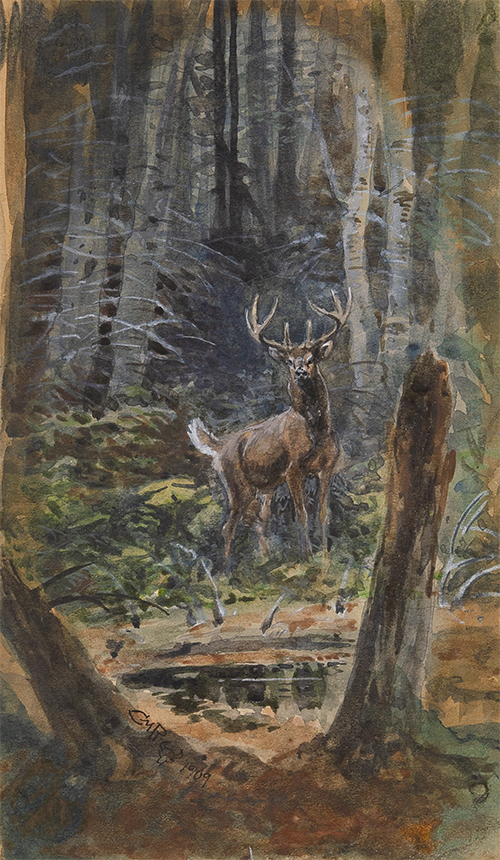
Deer in the Dell Tom Petrie Coll_w500
Deer in the Dell, 1909, Watercolor and gouache on paper, The Petrie Collection
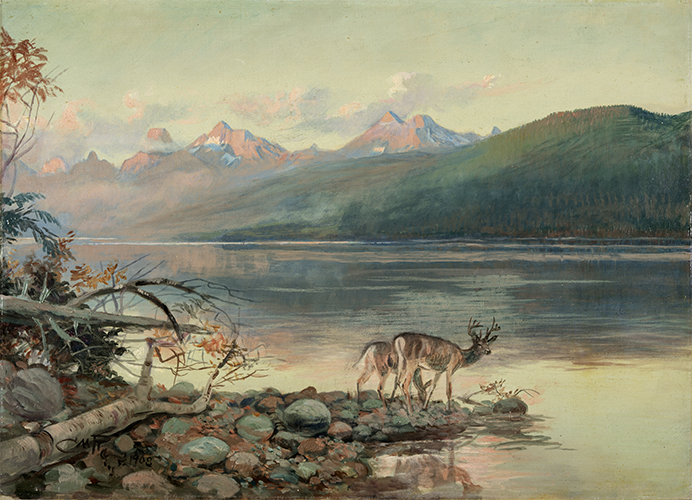
Deer at Lake McDonald 1908 Tom Petrie Coll-H500_
Deer at Lake McDonald, 1908, Oil on canvas, The Petrie Collection
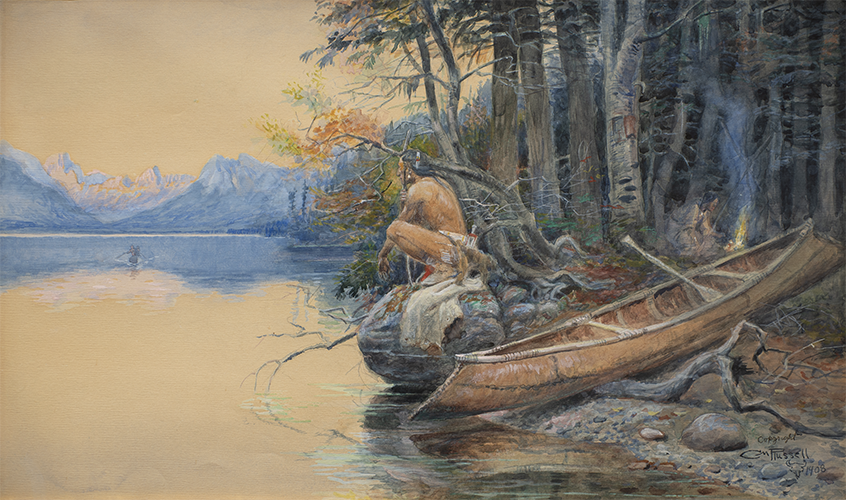
Land of the Kootenai Tom Petrie Coll_h500
Land of the Kootenai, 1908, Watercolor on paper, The Petrie Collection
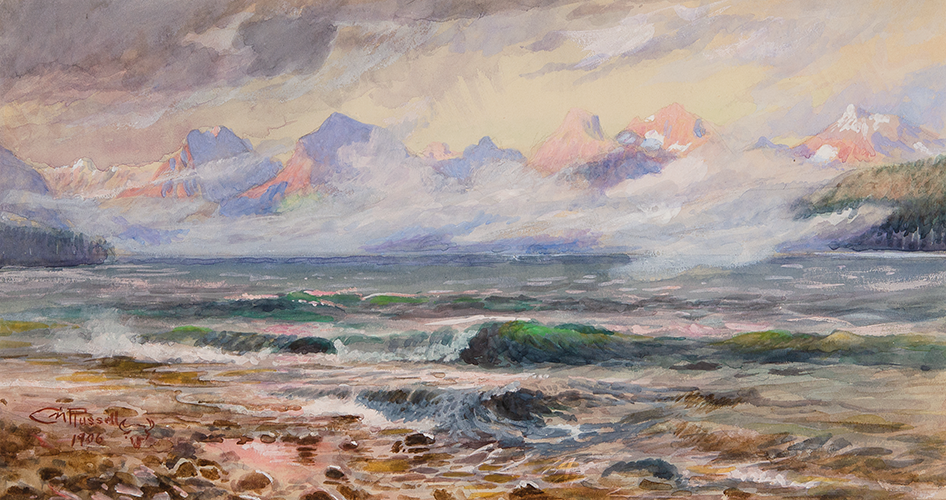
Storm Over Lake McDonald CMR MuseumH500
Storm Over Lake McDonald, 1906, Watercolor and gouache on paper, C. M. Russell Museum
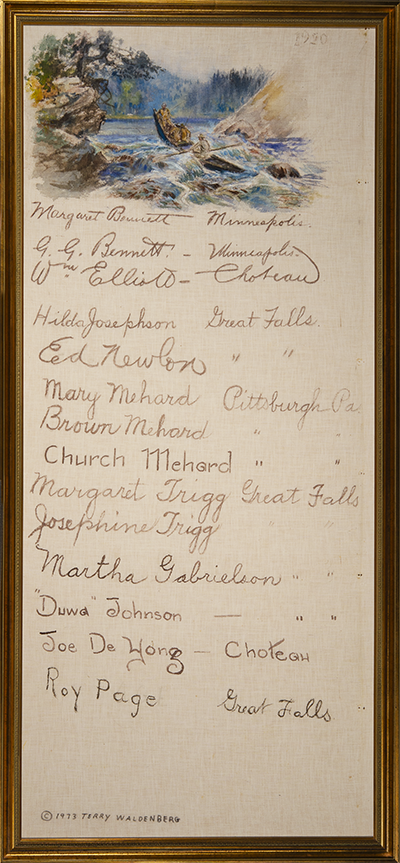
Privacy Screens, 996.27-w400
Bull Head Lodge Privacy Screen, 1920, Mixed media on muslin, C. M. Russell Museum
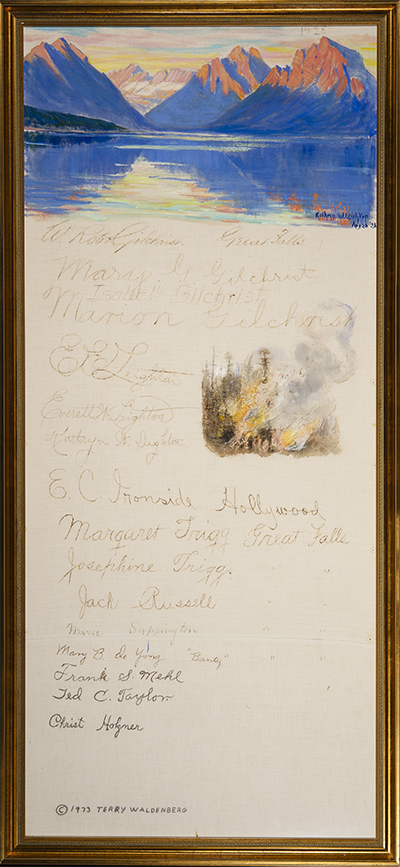
Privacy Screens, 996.27b-w400
Bull Head Lodge Privacy Screen, 1925, Mixed media on muslin, C. M. Russell Museum
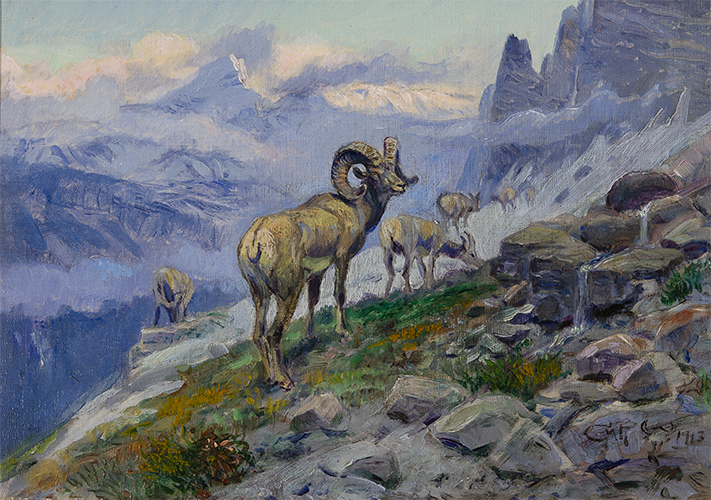
Mountain Sheep Grazing CMR MuseumH500
Mountain Sheep Grazing, 1913, Oil on canvas, C. M. Russell Museum
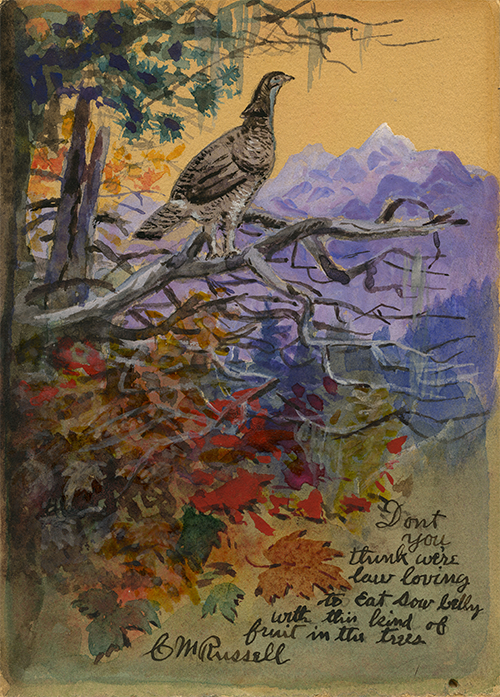
Law Loving Camp CMR MuseumW500
Law Loving Camp, n.d., Watercolor and gouache on paper, C. M. Russell Museum
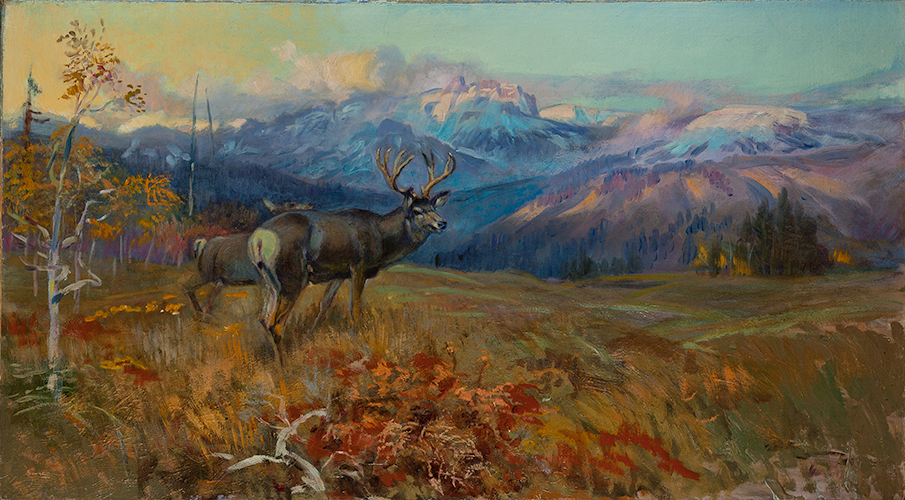
In Swan Lake Country Tom Petrie Coll_H500
In Swan Lake Country, 1926, Oil on canvas, The Petrie Collection
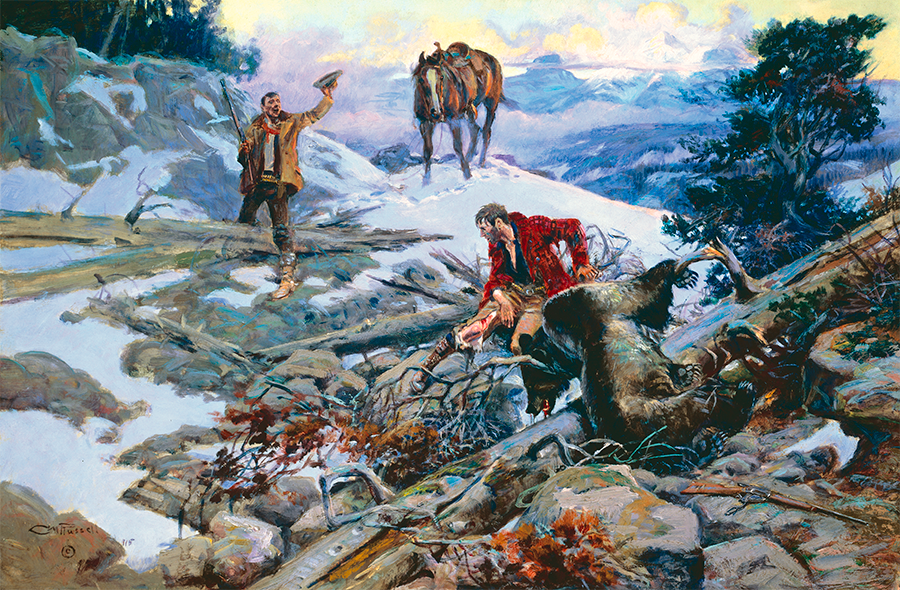
The Price of His Hide Tom Petrie Coll-webw900
The Price of His Hide, 1915, Oil on canvas, The Petrie Collection
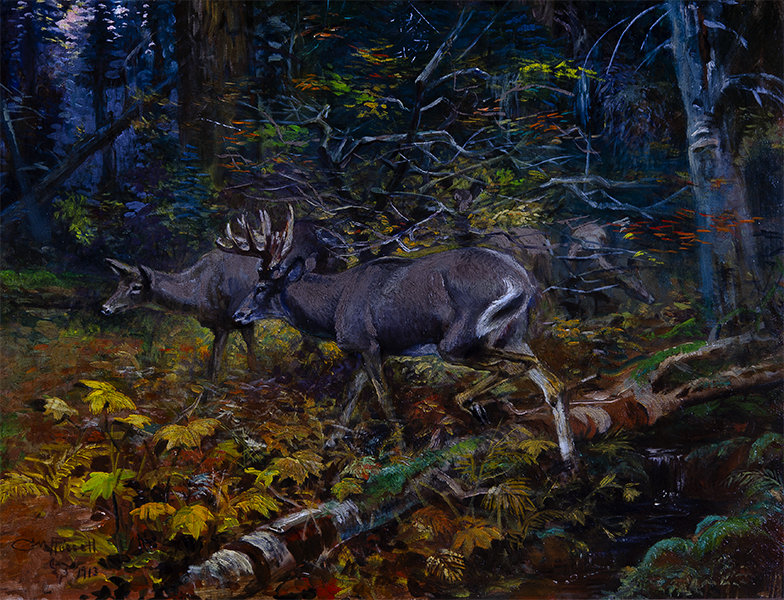
Deer in the Forest CMR MuseumH600
Deer in the Forest, 1913, Oil on canvas, C. M. Russell Museum
EXHIBITION ESSAY
RUSSELL’S RETREAT: Summers At Glacier National Park
By Scott Winterrowd
RUSSELL’S RETREAT: Summers At Glacier National Park
By Scott Winterrowd
The story of Glacier National Park begins nearly 170 million years ago, when massive glaciers created the dramatic scenes of lakes and valleys we see today. By the time Charles Russell was born in the mid-nineteenth century, around 80 glaciers still covered the area; today, only 26 remain. Beyond its ice, the park harbors unique ecosystems, from arid climate typical of much of Montana to the lush conditions around Lake McDonald, which resemble an inland temperate
rainforest. Fed by Pacific Maritime weather patterns that sweep moisture eastward, the forests thrive with old-growth stands and rich biodiversity.
For centuries, Indigenous peoples have lived among these lands—the Blackfeet [the Niitsitapi] on the eastern plains and the Kootenai [Ksanka or Ktunaxa], Salish [Séliš], and Pend d’Oreille [Ql’ispé] in the Western Valleys. The Kootenai, who called the area Ya∙qawiswit’xuki or “the place where there is a lot of ice,” held a deep connection to the glacial landscapes. Today, the Flathead Indian Reservation southwest of Glacier is home to three tribes: the Bitterroot Salish, the Upper Pend d’Oreille, and the Kootenai. To the west of the park live the Blackfeet Nation on the Blackfeet Indian Reservation, bordering Canada to the north.
Land of the Kootenai Tom Petrie Coll_h500
Land of the Kootenai, 1908, Watercolor on paper, The Petrie Collection
In Swan Lake Country Tom Petrie Coll_H500
In Swan Lake Country, 1926, Oil on canvas, The Petrie Collection
It wasn’t until 1910 that Glacier was established as a national park, resulting from the combined forces of scientific advocacy, increased access via the railway, and personal bonds with the land. Naturalist George Bird Grinnell’s 1885 visit to the Saint Mary Lakes region inspired his decades-long effort to secure federal protection for the region that would become Glacier. Shortly after, in 1891, the arrival of the Great Northern Railway made the area more accessible to settlers and visitors. Among its early new inhabitants during this time were Charles and Nancy Russell, who had first visited the high country in 1904 and in 1905 purchased property where they would build a cabin along Lake McDonald the following year.
For the Russells, their new tradition of summers at the lake became a retreat from the demands of daily life, with Charlie finding in Glacier the same spirit he had discovered in his youth camping with Jake Hoover in the Little Belt Mountains of central Montana. When Charles and Nancy built their summer retreat on the southwestern end of Lake McDonald, near Apgar, they first named it Kootenai Lodge in honor of the Indigenous people who had called the area home.
The most striking feature inside the main cabin was the fireplace. Constructed of cement in 1907, its artistic value far exceeded its utilitarian purpose. On the front face, Russell and his friend, fellow artist Philip Goodwin, etched sixteen nature scenes depicting the wildlife found around Lake McDonald. In the many photos taken inside the lodge, the fireplace was the centerpiece.
Before their first year in the cabin had ended, however, they rechristened it Bull Head Lodge, in reference to the bison skull that Russell used as part of his signature. In the early years when canoeing across Lake McDonald was the only way to access the secluded property, an actual bison skull hung from a birch tree along the lakeshore was the lone visible sign of the lodge from the water.
The initial 1906 cabin was a small structure of hand-hewn logs with a modest porch that faced the lake. Over the years, the back of the cabin was added onto and, in 1916, the Russells built a second cabin on the site as a studio and guests’ quarters. Despite later additions, the lodge never aspired to grandeur; its charm lay in its rustic nature.
In a similar fashion, the framed muslin privacy screens that divided the cabin’s interior evolved considerably beyond their original function. The screens served as a logbook each summer with guests signing their names directly onto the muslin, and visitors with artistic leanings embellished the fabric with paintings, caricatures, and sketches. Over two decades, the accumulation of names across the screens recorded a close-knit community at the lodge, featuring familiar characters such as the Trigg family, fellow artist Olaf Seltzer, and Russell’s protégé Joe De Yong.
Even as Charlie and Nancy entertained their recurring cast of friends and guests, Russell immersed himself in the rhythms of the forest and the serenity of nature. Life at Bull Head Lodge was kept intentionally unpretentious. Days were filled with fishing excursions on the lake or watching Russell paint on the deck, and evenings brought the circle of guests together outdoors, where Russell would amuse listeners with the humorous tales that made him known as much as a performer as a painter.
The early works Russell made here reflect the simplicity of these days around the lodge; many are intimately scaled scenes featuring the deer and encompassing landscape, and a number were made as gifts to close friends who visited during the summers. Even the very materials found around the site became part of Russell’s work: he utilized birchbark as a support for watercolors and fashioned gnome-like sentries out of moss, twigs, and more birchbark to stand guard at the cabin.
A work Russell made in 1906, the year of Bull Head Lodge’s construction, stands out as one of the few pure landscape subjects Russell painted. In it are glimpses of how the environment of Lake McDonald would leave a lasting mark on Russell’s artistic vision. Although Russell would complain that he could not properly capture the lake in paint, in Storm Over Lake McDonald he succeeds in communicating the power of a small storm through the turbulent waves, the aqua hue of the glaciated water set before the distant peaks. Glacier’s landscape—with its vast distances, shifting light, and glacial blues—reshaped his palette and atmosphere across his artmaking, imbuing later works with a similar, cooler tonal quality.
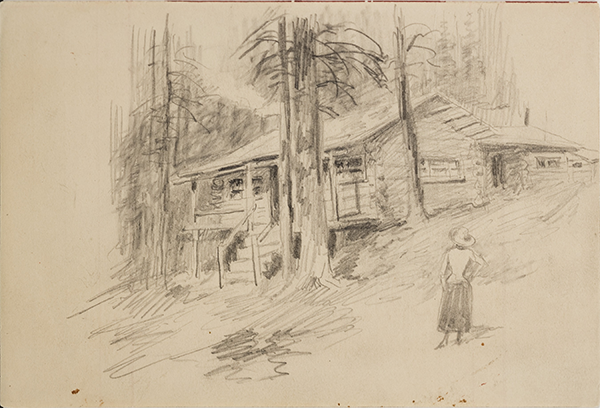
2009_321 Untitled_CMR’s cabin_DAM-w600
Philip R. Goodwin, Untitled (Charles Russell's Cabin at Lake McDonald, Montana), ca.1907, Pencil on paper, Denver Art Museum
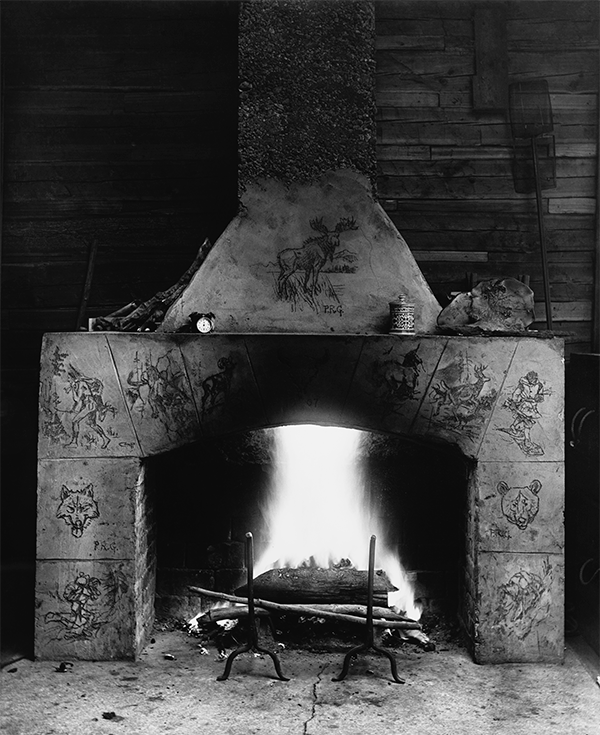
03-PhotoTex-Fireplace-PrintFinal
Photograph of the decorative fireplace in Bull Head Lodge, Amon Carter Museum of American Art
Storm Over Lake McDonald CMR MuseumH500
Storm Over Lake McDonald, 1906, Watercolor and gouache on paper, C. M. Russell Museum
What’s more, Russell would also reprise themes he developed in his western narratives of the 1890s and 1900s, but place these new works in settings reminiscent of Glacier, from the towering silhouettes of the Continental Divide to the peaks across Lake McDonald, including Mount Cannon, Brown Mountain, the Little Matterhorn, Edwards Mountain, Gunsight Mountain, and Mount Jackson. These forms became more than background; they were compositional anchors, evidence of how Russell’s environment intertwined with his art. Though he continued to revisit his beloved themes of western life, Russell increasingly turned to nature as a subject late in his career, an artist indelibly altered by mountains, woods, and glacier-fed lakes.
For the Russells, their guests at Bull Head Lodge, and so many who came before and after them, Glacier would always be more than a landscape—it was, and is, a sanctuary to restore the spirit and preserve the natural beauty of the American West. In a letter, Russell wrote,
“I spend my summers at Lake McDonald on the west side of the mane [sic] range where I have a cabon [sic]. Is about as wild a place as you can find these days and that is what I like… If it’s laying down you need Lake McDonald is the best ground in the world and my lodge is open and the pipe lit for you and yours. You know that lake country sings the cradle song to all who lay in her lap” (L.L. Peterson, Charles M. Russell: Printed Rarities from Private Collections, Missoula, Montana, 2008, p. 83).
Through the work he made in and inspired by this place, and in the preservation of Glacier’s wilderness today, may we all continue to hear the lake country sing.
#MuseumFromHome
Russell’s Retreat: Summers at Glacier National Park
Discover how the natural beauty of the Montana wilderness inspired cowboy artist Charles Russell. Take a 360-degree online tour of Sid Richardson Museum’s latest exhibit.